Reimbursements overview for Admins
Note: This article primarily applies to Ramp Administrators. Cardholders may find other articles in the Reimbursements section to be more applicable.
Overview
Ramp aims to help you handle all company expenses in a single place. This includes paying employees back for mileage or out-of-pocket expenses via our Reimbursement product.
With Reimbursements, both domestic and foreign employees can submit requests for reimbursement, managers can review and approve these expenses, and Ramp will automatically facilitate payment to the employee within 3 business days. It's the fastest reimbursement product on the market.
Setting up reimbursements
For a detailed setup guide, check out this article.
The basics are:
Set your preferred payment method
Ramp enables and recommends paying employees directly to their bank account (via ACH if they're in the US and via wire to more than 50 foreign countries).
Choose a company bank account to make payments from, have employees follow a simple process to connect their bank account, and begin making payments in no time. If you prefer to handle payments outside of Ramp, toggle on "Allow payments outside of Ramp," and you can use any method you like to handle payments off-platform.
Set up your mileage policy
Choose whether or not you will allow mileage reimbursements and how much to pay per mile. You can also assign different rates based on department, place of residence, or individual employees.
Google maps mileage
Ramp's Google Maps mileage feature populates the mileage after employees enter a start and end location. This will then automatically compute how much to reimburse employees based on the route with the fewest number of miles. Mileage rates default to the IRS Standard Mileage Rate for business purposes for that calendar year.
Deduct commute
You can also set up the ability for your employees to deduct their commute by following these steps:
- Go to Expenses on the left panel
- Select Reimbursements
- Click the triple dot menu in the upper right-hand corner then Settings
- Navigate to Mileage
- Click Enable commute deductions
Employees will then have the option to set their home and office addresses and to choose whether to deduct one-way or round-trip fares.
International mileage reimbursements are available for the following countries on both the web and mobile iOS experience: Canada, United Kingdom, Spain, Germany, France, Australia, Belgium, Poland, Ireland, Netherlands, Finland, Denmark, Austria, and South Africa. Ramp automatically reimburses international employees at their respective country's mileage reimbursement rate.
Note: You may manually adjust your mileage rate at any time by going to your Expensestab > Reimbursements > Settings (upper right-hand corner) > Mileage. Also, if you disable mileage reimbursements, past mileage reimbursements cannot be edited.
Set up your per diem policy
Admins can configure per diem rates for reimbursements by going to Expenses > Reimbursements > overflow menu (3 dots) > Settings > Per Diem tab. Choose between GSA Standard rates or a custom daily rate. For businesses with international employees, Ramp also supports country-specific statutory per diem rates for 20 European countries. See the detailed setup article here.
Set up your submission policy
Confirm what information will be required when an employee submits a reimbursement, including receipts, memos, and any important accounting categories. More information on that here: Submission Policies
Set up your approval policy
Set up a custom approval workflow to ensure that all submitted reimbursements are reviewed and approved before paying. More information here: Approval policies
How do employees submit reimbursements?
Submitting reimbursements through Ramp is easy. With just a few clicks, employees can create a reimbursement draft, fill it out with the relevant details, and get it sent off for approval.
Check out this article, Submitting reimbursements, for more information on:
- Editing reimbursement amounts
- Bulk approving reimbursements
- Foreign transaction reimbursements
- International reimbursements
- Reimbursement payment options
Payment flow and timing
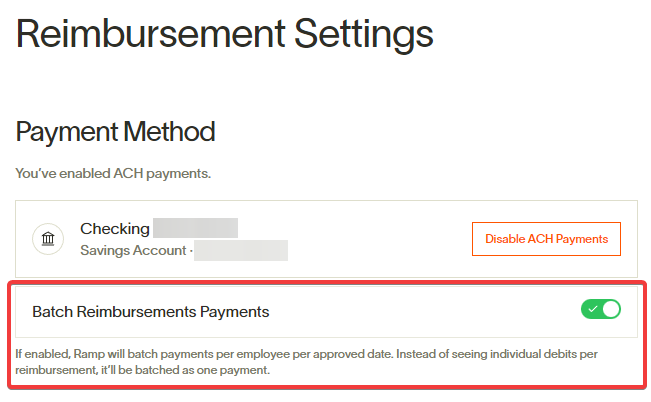
By default, Reimbursements and payments are 1-1. For each reimbursement, one debit will be made to your business bank account, and one credit will be made to the employee's bank account. That said, payments can also be batched daily by employee if preferred. You can enable or disable this feature in the Reimbursements Settings page.
Batch reimbursements
With batch payments enabled, we will send a single payment daily to an employee's bank account for all the reimbursements approved in the last 24-hour period and withdraw one amount per employee from your connected bank account. This means that if an employee submits ten reimbursements for $4 each, instead of sending your employee receiving ten separate payments for $4 as we would normally expect, we'll send a single batch payment to their bank account for $40 instead. When we debit the business, we will debit once for $40 as well in this case.
Reimbursements will show in your bank statement using the following format:
"RAMP REIMBURSE," followed by the first initial and last name of the employee being reimbursed.
To see which reimbursements were included in an ACH batch, you can click the relevant reimbursement in Ramp, click "Batched with other reimbursements", and get taken to a filtered view of all reimbursements included with that payment.
Please note: international reimbursements can not be batched at this time.

Accounting flow
Accounting for reimbursements is lightning fast like our Ramp card transactions. Currently, we use Bills to sync reimbursements to your Accounting Provider. If you've configured direct payments, we'll also sync a Bill Payment for you.
Check out this article for a more detailed breakdown: Syncing reimbursement to accounting
Reimbursing candidates and non-employees
If you need to reimburse job candidates or other non-employees for out-of-pocket expenses—like travel or parking—you can do so using Ramp’s Guest role. This limited-access role is ideal for individuals who need to submit reimbursements without being full users on your Ramp account.
To use this functionality:
- Assign the Guest role to the individual
- Guests can submit reimbursement requests directly through Ramp
The Guest role is available to businesses enrolled inRamp****PlusLearn more about Guest user functionality here.
Frequently asked questions
Can I submit reimbursements for someone else?
Yes. Anyone with the owner, admin, or Accounting role can submit reimbursements for another user as long as they have a bank account linked for ACH payments, and if payments outside of Ramp are not configured. Here are the steps:
- Navigate to Expenses > Reimbursements tab.
- Click Request Reimbursement .
- Add the relevant receipt.
- Use the Choose person option to select the user who should receive the reimbursement.
- Click Submit —you're all set.
Can I use Ramp for cash advances or prepayments for employee expenses?
Ramp does not offer a general cash advance or prepayment workflow for employee expenses. For expenses that need approval before purchase, issue Ramp cards or funds, or have employees submit a booking request before purchase in Booking travel on Ramp: Admin guide when they are booking flights or hotels in Ramp Travel. For out-of-pocket expenses, employees submit reimbursements after they pay. The exception is per diem reimbursements, which you can configure to allow submission before travel in Reimbursements set up.
Can I set up different policy requirements for mileage reimbursements?
Yes. If you do not want to require your employees to upload a receipt for mileage for example, you can update your submission policy for mileage reimbursements. You'll be able to update your submission policy for both mileage and regular reimbursements.
How is mileage distance calculated?
We automatically calculate the distance between the start and end locations for a mileage reimbursement. The route we derive for that travel is based on the current road conditions (which account for traffic patterns and road closures), but this can also be manually overridden if needed.