Microsoft Entra integration: Set up SCIM provisioning
Overview
System for Cross-domain Identity Management (SCIM) can be set up to connect your Identify Provider (IdP) with your Ramp account. SCIM allows you to invite and deactivate Ramp users directly from your IDP. For general information on using SCIM with Ramp, please review this article.
This article explains how to set up the Microsoft Entra integration from your Ramp account. After finishing this setup, you can also optionally enable role syncing from Entra by following this article.
We've called out many suggestions and "things you should know" for using the integration so we strongly recommend you read this before setting up your SCIM integration.
Note: Changes made via SCIM may take up to 5 minutes to be reflected in Ramp, and in rare cases, slightly longer. For urgent actions, such as terminating a compromised Ramp user or card, we recommend completing the action directly in Ramp.
Set up the integration on Ramp
Before you begin
- Determine which profile field you want to use for the user's department in Ramp. By default this is set to "department" but you can map to any profile field in Microsoft Entra. Other common options are "cost center", "organization", or "division".
- Determine which profile field you want to use for the user's location in Ramp. By default this is set to "city" but you can map to any profile field in Microsoft Entra. Other common options are "cost center", "locale", "state", and "country code".
- Ensure each Microsoft Entra user has a department and location. After activating SCIM, use People > page actions > Configure Entra settings > Fallback user fields to set a default for either missing value before provisioning. Ramp cannot provision a user if either value is absent from both Entra and its corresponding default.
- "Groups" in Microsoft Entra can make it easier to manage user assignments. If you choose to use Microsoft Entra groups, please fully review the "inviting user groups" section below.
- If you already have users on your Ramp account:
- Confirm that the employee profile information in Ramp matches the data in your IDP. When you provision a user via SCIM and they already exist in Ramp, the IdP becomes the source of truth and will override the user's Ramp profile if it doesn't match.
- If a user's email address doesn't match, SCIM will use the Microsoft Entra email address to create a second account for the user.
- If you are disconnecting from HRIS to set up SCIM
- Please ensure that the HRIS fields that you use for Department and Location are synced to your IDP (Microsoft Entra). If you disconnect HRIS, and the data does not match your IDP, the SCIM integration will override the employee profile information on Ramp. (Reminder that you can map to any IdP field you'd like.)
- We recommend contacting your Ramp partner for support
- (Later) Once you have the integration set up, before you terminate anyone via SCIM, you’ll want to determine your preferred options for handling user deletion in regards to how Ramp will handle their cards and status in approval chains. (See Terminations section below)
- Know the supported features
- Create users (Invite to Ramp)
- Update user attributes (Name, Department, Location, Manager)
- Deactivate users
Integration setup
- Go to Settings > Apps
- Search and select Microsoft Entra
- Note: You cannot integrate with both SCIM and HRIS at the same time. If you are connected to HRIS, you will need to disconnect the HRIS integration in order to set up SCIM.
- When you select your provider, you will be prompted with instructions on how to set up the integration with Microsoft Entra.
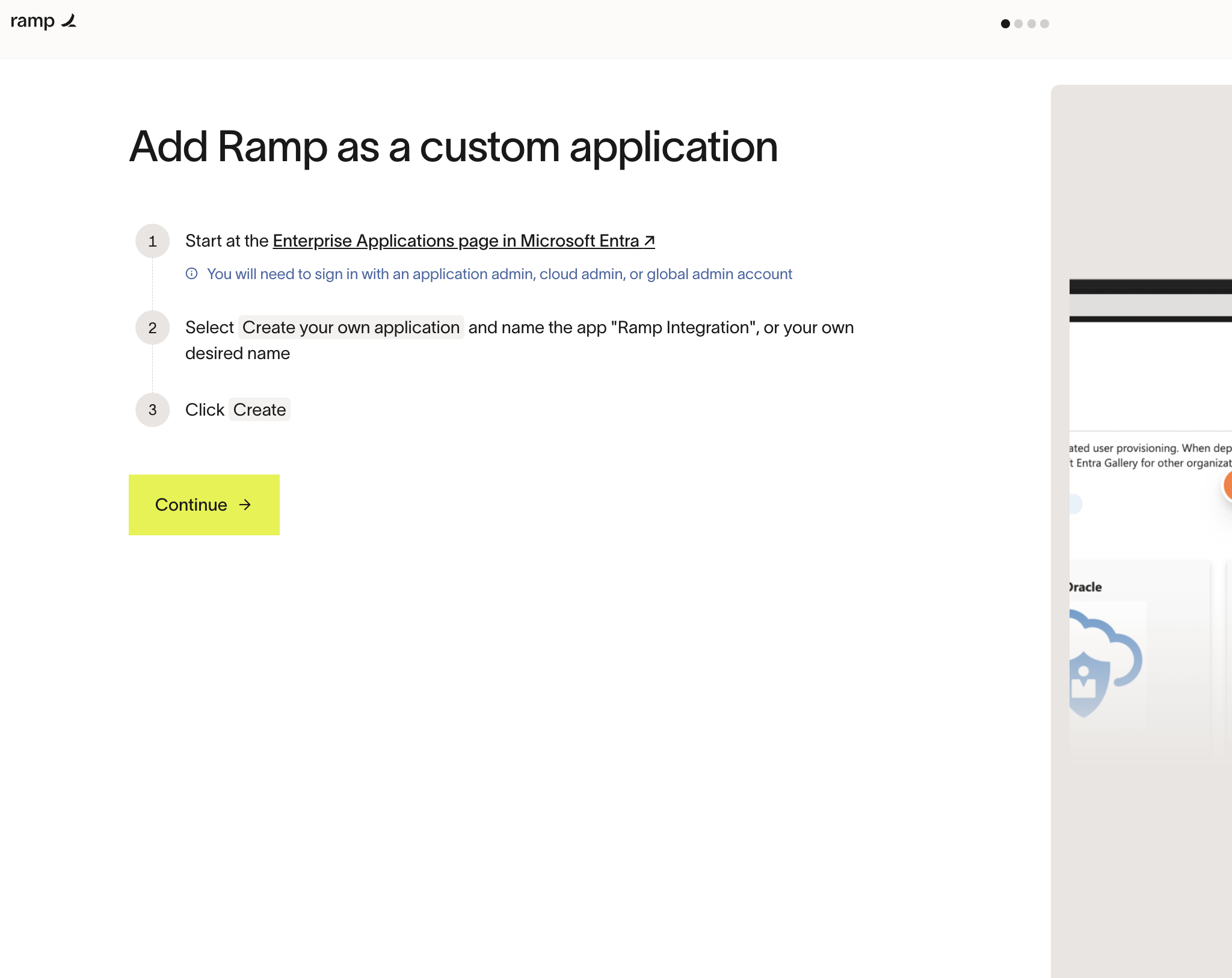
- Install the Ramp app in your Microsoft Entra tenant.
- Use the provided URL and API token from your Ramp dashboard to configure the app in Microsoft Entra.
- Follow the directions in the setup flow to map the appropriate Microsoft Entra attributes to Ramp attributes.
- Ensure that the following are checked and enabled in the "Provision Microsoft Entra ID Users" menu:
- Create
- Update
- Delete
Setting the attribute mappings
The following are the recommended attribute mappings. Please note: that you can assign any desired Microsoft Entra value to the Ramp attributes. Ensure the attribute names match the capitalization below (e.g., in "userName" make sure the "N" is capitalized).
The optional mobile attribute must use E.164 format when mapped.
| customappsso Attribute | Value | Notes |
|---|---|---|
| userName | userPrincipalName | |
| active | Switch([IsSoftDeleted], , "False", "True", "True", "False") | |
| emails[type eq "work"].value | ||
| name.givenName | givenName | |
| name.familyName | surname | |
| addresses[type eq "work"].locality | city | This value will be used to set the user’s location in Ramp. If the location does not exist in Ramp yet, it will be automatically created. If Ramp receives a request to create or update a user with no locality set, it will be rejected unless you have set a default location. |
| externalId | mailNickname | |
| urn:ietf:params:scim:schemas: extension:enterprise:2.0:User: employeeNumber | employeeId | |
| urn:ietf:params:scim:schemas: extension:enterprise:2.0:User: department | department | This value will be used to set the user’s department in Ramp. If the department does not exist in Ramp yet, it will be automatically created. If Ramp receives a request to create or update a user with no department set, it will be rejected unless you have set a default department. |
| urn:ietf:params:scim:schemas: extension:enterprise:2.0:User: manager | manager | This value is the Ramp identifier for the user's manager. |
| phoneNumbers[type eq "mobile"].value | mobile | Optional, but must use E.164 format if specified. |
Note: Ramp uses the synced number to send texts about the user's invitation if invite texts are configured in invite settings.
Attribute <> Ramp user profile mapping
| Attribute Name | Ramp User Profile | Required? |
|---|---|---|
| userName | Not shown on the Ramp user profile. We use this as a unique identifier on the back end. | Yes |
| active | Activation/deactivation state for Ramp user. We do not handle full account deletion through SCIM (see below). | |
| emails[type eq "work"].value | Email address | |
| name.givenName | First name | |
| name.familyName | Last name | |
| addresses[type eq "work"].locality | Ramp location | |
| externalId | Alternate unique identifier provided by Microsoft Entra. Not shown in Ramp. | |
| urn:ietf:params:scim:schemas: extension:enterprise:2.0:User: employeeNumber | Employee ID, shown in some data exports. | |
| urn:ietf:params:scim:schemas: extension:enterprise:2.0:User: department | Ramp department | |
| urn:ietf:params:scim:schemas: extension:enterprise:2.0:User: manager | Ramp identifier for this user's manager. | |
| phoneNumbers[type eq "mobile"].value | Mobile phone (user confirmation required) | No |
Once you complete setup, you’ll land on the SCIM integration page where you can view and configure your SCIM settings. Read more about the SCIM settings page here.
Troubleshooting
If you run into any issues configuring SCIM, open your Ramp dashboard and select Get help or Ask Ramp. Ask Ramp to help troubleshoot the setup issue you are seeing in your SCIM configuration, and continue in the same help flow if you need a next step.
Provisioning users
Invites
When you connect to your IdP (Microsoft Entra) via SCIM, you will be able to automatically invite users to Ramp from your IdP.
Ramp requires the following information to send the invite:
- First Name
- Last Name
- Email address
- Department
- Location
If a user has a manager assigned to them in your IdP, you can push that information to Ramp as well, and we recommend doing so. (This is configurable from Microsoft Entra)
Note that if you invite a user with a manager who has not been invited to Ramp yet, their manager will not be configured until they are provisioned to Ramp.
To send a user invite via SCIM, Ramp must receive every required field. Department and location can each come from Microsoft Entra or the corresponding integration default. If Ramp cannot resolve a required field after applying these defaults, the request will fail. You can track errors/unsent invites in Microsoft Entra.
Note that you can map any Microsoft Entra field to the Ramp attributes. The recommended fields are pre-populated in Microsoft Entra, but you can change them.
SCIM user creation follows the invite preference in your SCIM settings. See how SCIM invite preferences control user creation.
If you also have SSO/SAML set up, your users can access Ramp using SSO and don't need to accept the invite via email.
Inviting user groups in Microsoft Entra
You have the option to invite users as individuals or as part of user groups from your Microsoft Entra account.
It is common to have workflows in Microsoft Entra that automatically add or remove a user to/from a group based on certain criteria. If a user is (automatically or manually) moved from a group where they are assigned to Ramp, they will be immediately deactivated from Ramp unless they are still in draft, in which case Ramp deletes them.
Pushing groups from Microsoft Entra to Ramp
Assign a Microsoft Entra group to the Ramp app to create the group in Ramp and provision its users.
To create a Ramp group from Microsoft Entra:
- In Ramp, open SCIM Settings and make sure Group sync is enabled.
- In the Microsoft Entra admin center, open the Ramp Enterprise Application.
- Select Users and groups.
- Select Add user/group.
- Under Users and groups, assign the group you want to push to Ramp.
Note: Group-based application assignment requires Microsoft Entra ID P1 or P2.
Note: Assigned groups must contain users directly because Microsoft Entra assignments do not cascade to nested groups.
User setup in Ramp
You can optionally enable role syncing from Entra by following this article. If you don't choose to enable role syncing: if a user is assigned as someone’s manager in your IdP when they're invited, we will automatically assign them the Manager role on Ramp. Otherwise, all users invited via SCIM will be assigned the Employee role. You can update a user’s role from your Ramp account after they accept their invite.
When a user is invited via SCIM, we will issue any default Spend Programs that you’ve configured for your business.
Deactivations
When a user is no longer assigned to the Ramp app in their IdP, Ramp deactivates rather than deletes them; draft users are deleted instead. Read more here for considerations of what this entails.
Automatic updates
SCIM automatically updates the supported user information listed below when those values change in your IdP. For these fields, your IdP is the source of truth.
- Name
- Department
- Location
- Manager
- Phone*
- Role
Email changes are supported via SCIM. By default, when an email is updated in your identity provider, the employee receives a verification email and must confirm the change before it takes effect in Ramp. You can read more about handling user updates here.
Note: For Phone, Microsoft Entra does not overwrite a user's confirmed Ramp phone number. Users can still change and confirm their phone number in Ramp.