Ramp Managed Investment Account Overview
Overview
Ramp Banking lets businesses invest excess cash into Managed Investment Accounts. The Investment Account is an advisory account offered by Ramp Advisory LLC. Ramp Advisory LLC is an SEC-registered investment adviser and a wholly owned subsidiary of Ramp Business Corporation. Moment Advisors, LLC constructs and manages the portfolios as subadviser. The portfolios are designed to optimize yield and preserve capital, allowing you to save time and earn competitive yields with automated portfolios. This differs from the former Ramp Investment Account (Self-Directed), which invested only in FUGXX, a money market fund. Managed Investment Accounts allow you to invest directly in a mix of investment options. To compare yields and features, see the Business Investment Account product page.
Contact Sales about Managed Investment Account
If you want to learn more about a Managed Investment Account before opening one, eligible businesses with an assigned Ramp contact can find their contact card in Settings > Company Profile. If you cannot access Company Profile, ask a Ramp Admin to check whether your business has an assigned Ramp contact. If your business does not have an assigned Ramp contact, go to Ramp's Business Banking page and use the demo or sales option to contact Sales.
Set up a Ramp Managed Investment Account
- Make sure you’ve already opened a Ramp Checking Account . If not, you can open an account in under a minute here .
- In Ramp, go to Banking > Banking > click New in the top right > Investment Account
- Complete the onboarding flow:
- Select your short-term cash target and investment preferences
- Review, customize, and accept your portfolio
- Review your account agreements and submit the application
- Once you open the account, it may show as under review. Reviews can take anywhere from a few minutes up to 48 hours, after which you should be able to transfer money into your Managed Investment Account and see it in your Banking dashboard.
Deposit and withdraw funds from a Managed Investment Account
Managed Investment Accounts use deposit and withdrawal for the transactions called buy and sell orders in a Self-Directed Investment Account. Use Move money to deposit funds from your Ramp Checking Account or withdraw funds from your Managed Investment Account.
- When you request a deposit into your Managed Investment Account, Moment will:
- Invest your cash into a diversified set of fixed-income products aligned with your selected strategy
- Reinvest coupons and maturities
- Rebalance and raise cash for withdrawals
- When you request a withdrawal from your Managed Investment Account:
- Moment will sell securities as necessary to cover the requested amount
- Securities are typically available as cash at the end of the next business day
- Available funds are automatically returned to your Ramp Checking Account
There are no lockups, but the timing of withdrawals is subject to market hours and settlement cycles.
What does the managed investment account invest in?
Ramp Banking portfolios are diversified, investment-grade fixed-income strategies. Depending on the specific strategy, portfolios may include the following underlying assets:
- US Treasury and Agency securities
- Investment-grade municipal bonds
- Investment-grade agency and mortgage-backed securities
- Certificates of deposit, cash sweeps, time deposits
- Investment-grade corporate bonds and commercial paper
- Repurchase agreements and other high-quality short-term instruments
- Money market mutual funds
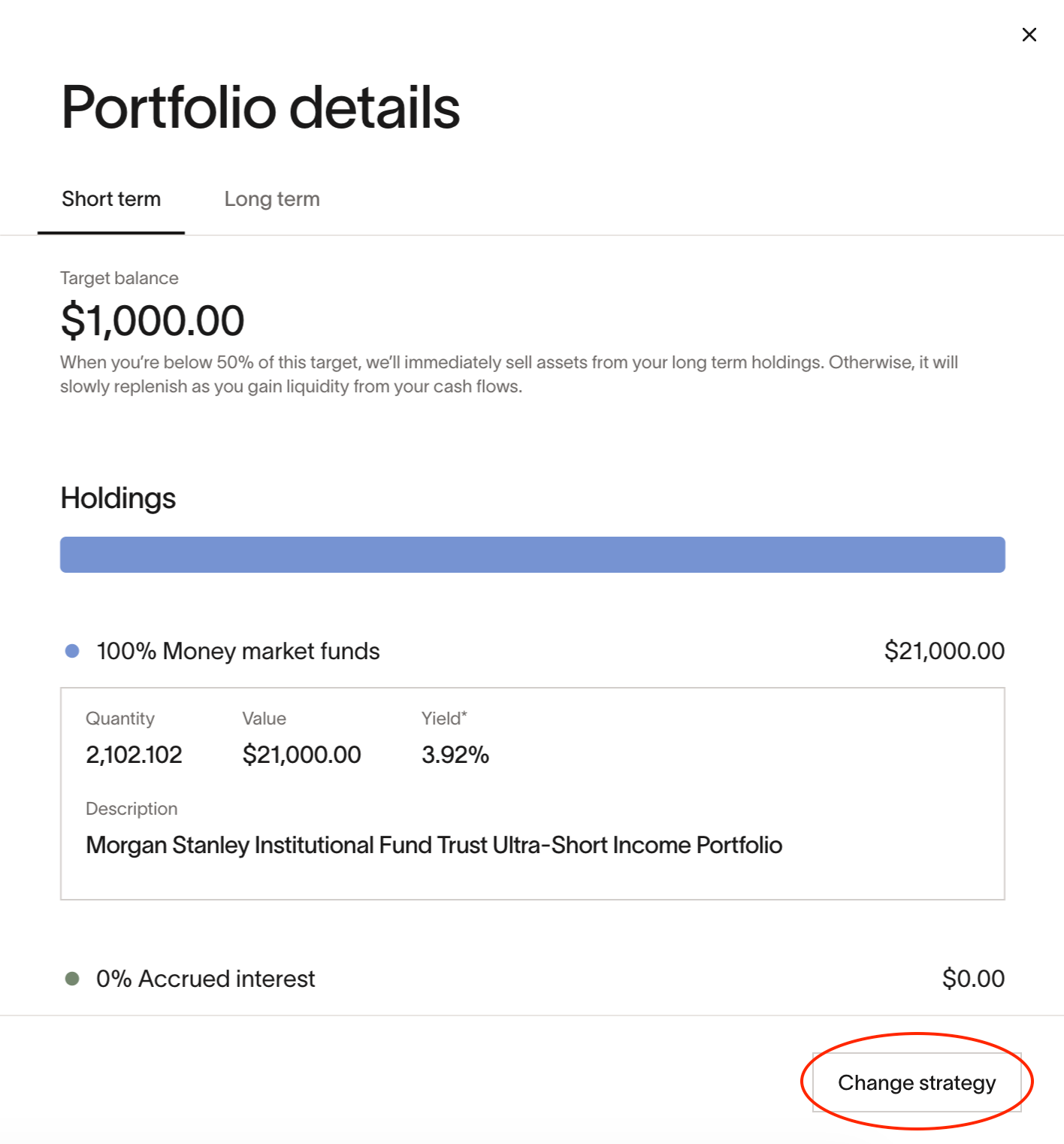
Moment uses portfolio models to manage duration targets, sector weights, credit quality, and issuer diversification within predefined limits. Please note that Moment determines exactly which investment options after you select your strategy. You won’t be able to see an exact breakdown of where the money is invested during onboarding. After onboarding, you can view the analytics on and details of your portfolio including total value, average duration, and time to maturity under Portfolio details. You can also use Portfolio details to update your strategy after you open an account, including your cash target.
How is this different from the self-directed investment account within Ramp?
The former Self-Directed Investment Account invested in a single Invesco money market fund that held government debt, such as U.S. Treasuries.
With a Managed Investment Account, your business can select a strategy based on your risk tolerance to invest directly in a mix of mutual funds, government debt, and high-grade corporate bonds. This is similar to what a wealth manager does for larger businesses.
The Ramp Investment Account (Managed) account is split into two portions, one with a shorter-term mutual fund strategy and another with a longer-term investment strategy that seeks higher yield. This allows you to keep a target dollar amount highly liquid for near-term needs (end-of-next-business-day liquidity), while having everything above the target invested in longer-term investment options that seek higher yields.
Use the Reserve strategy for an option similar to a Self-Directed Investment Account
If you want an option similar to the former Self-Directed Investment Account, allocate funds to IJTXX in the short-term sleeve by selecting the Reserve strategy. IJTXX is a J.P. Morgan government money market fund that invests in short-term U.S. government instruments, maintains a stable $1 net asset value, and settles trades the same day. After you request a withdrawal, proceeds are typically available in your Ramp Checking Account by the end of the next business day.
How can I reset my short term cash target?
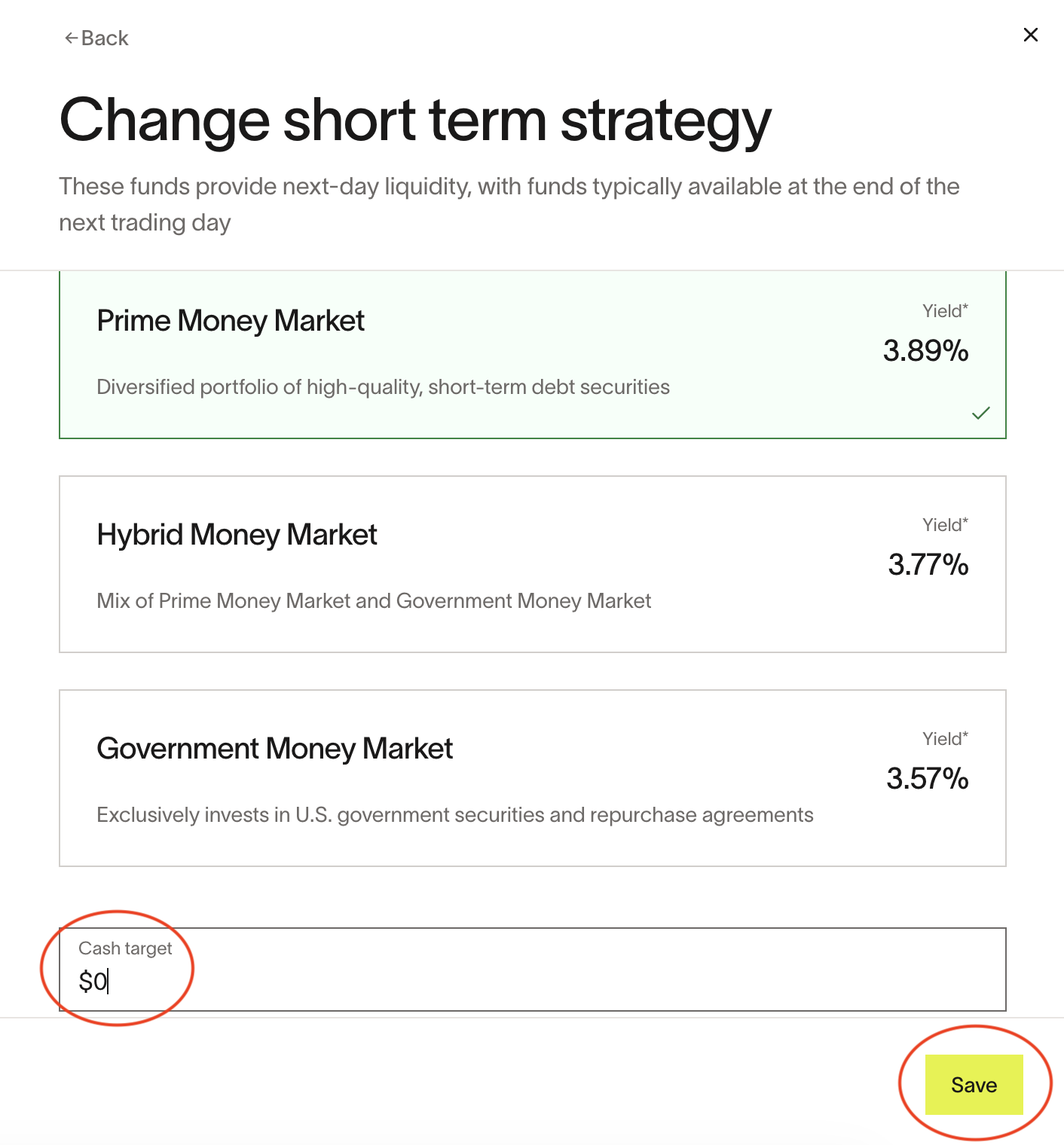
In the Investment Account (Managed) account page, click "Portfolio details." In the Portfolio details drawer, click "Change strategy," update the "Cash target" to your desired threshold, then click "Save."
Effective March 2026, Managed Investment Accounts have a $50,000 minimum short-term cash target. We are making this change based on observed account performance: when short-term cash targets are set below $50,000, accounts often need to trade more frequently. That can reduce yield because of transaction costs, especially when assets are sold before maturity.
If your current target is below $50,000, it will remain unchanged unless you update it.
Allocation to the long-term bond portfolio begins only after the $50,000 minimum is met and additional cash is available to invest. If you'd like to request a target below $50,000, contact Ramp Support. Requests are reviewed on a case-by-case basis.
How do funds move in my managed investment account?
Your Managed Investment Account automatically moves money between short-term and long-term investments based on the short term cash target you set. This helps keep cash available for near-term needs while investing excess funds for higher earning potential.
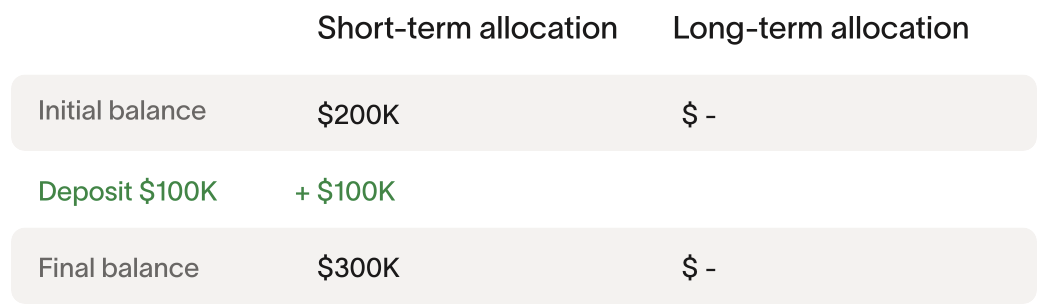
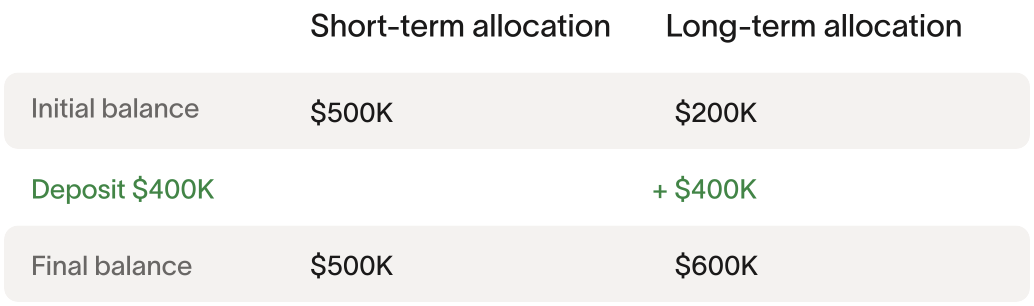
The following examples show how funds automatically move between your short-term and long-term allocations when you deposit or withdraw cash, assuming your short-term cash target is $500K.
Depositing funds
Scenario 1: Deposit funds and final balance is below short-term target
Scenario 2: Deposit funds and final balance is above short-term target
Withdrawing funds
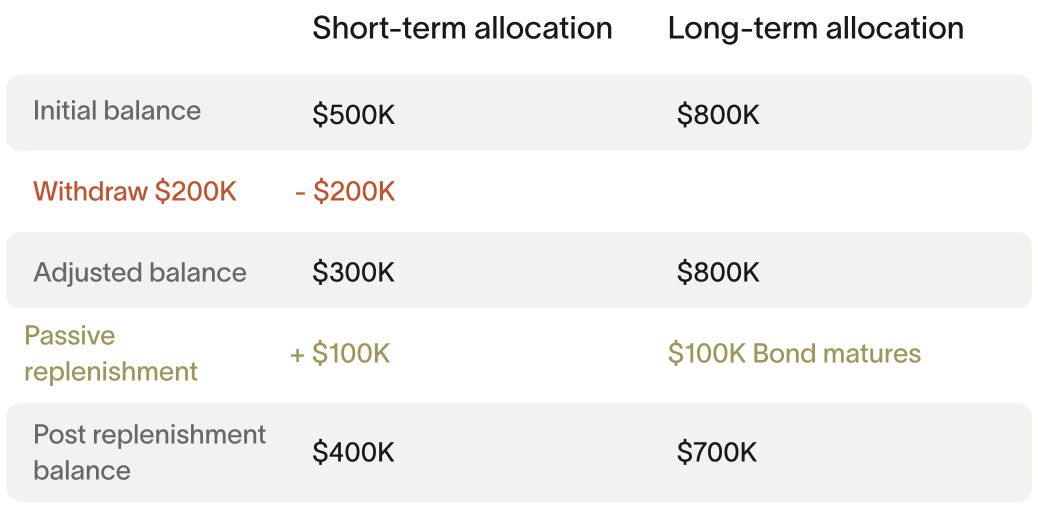
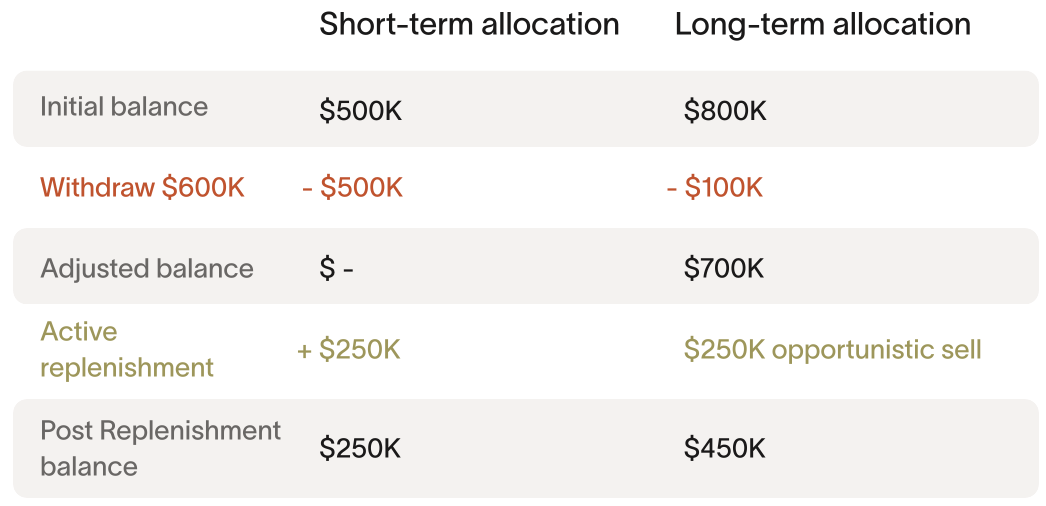
When your short-term balance falls below 50% of your cash target, Moment sells long-term holdings to replenish the short-term allocation.
Scenario 3: Withdraw funds and final short-term balance is greater than 50% of your target
Example: Make an unexpected small payment.
Scenario 4: Withdraw funds and final short-term balance is lower than 50% of your target
Example: Make an unexpected major vendor payment
Frequently asked questions
Who is Moment?
Moment Technology Inc. (“Moment”) provides automated, institutional-grade fixed-income portfolio management for corporate cash, helping companies put excess cash to work while preserving liquidity and minimizing operational overhead. Founded by a team that built systematic credit trading desks at Citadel, Moment brings institutional execution, portfolio construction, and risk management to both treasury and the wealth and asset management ecosystem. Today, Moment powers fixed-income workflows for firms such as Edward Jones, J.P. Morgan Private Bank, and LPL Financial—clients that collectively manage over $8T in assets. The team has raised $130M+ from leading investors including Andreessen Horowitz, Index Ventures, and Lightspeed Venture Partners.
Moment Advisors, LLC is the subadviser retained by Ramp Advisory LLC. Moment Advisors, LLC:
- Designs the investment models used for Ramp Banking
- Uses Moment’s technology to implement models and monitor portfolios
- Reinvests, rebalances, and adjusts portfolios over time as markets change
Contact Moment Advisors, LLC by mail at 395 Hudson Street, Floor 10, New York, NY 10014, by phone at +1 917-539-2721, or by email at [email protected].
How do Ramp Advisory LLC, Ramp, Moment, and Apex work together?
- Ramp Advisory LLC
- Offers the advisory account and provides investment advisory services
- Ramp Business Corporation (Ramp)
- Provides the dashboard and user experience for onboarding, funding, viewing portfolios, and requesting withdrawals
- Transmits customer instructions and preferences to Moment and Apex
- Does not hold customer assets
- Is a financial technology company, not an investment adviser, and does not provide investment advice
- Apex Clearing Corporation (“Apex”)
- Provides brokerage execution and custody as a broker-dealer and custodian and is a member of FINRA and SIPC
- Supports brokerage account creation and enrollment, trade execution, settlement, statements, and tax documents
- Participates in KYC and KYB review for brokerage onboarding
- Moment / Moment Advisors
- Acts as subadviser and constructs and manages Ramp Banking portfolios
- Uses rules-based models and its portfolio management system to generate trades
- Oversees risk, diversification, and liquidity within each strategy
Is my managed investment account insured?
No. The Managed Investment Account is not insured by the FDIC, is not a deposit product, and may lose value.
It’s important to distinguish between custody protection and market risk:
- Your Managed Investment Account, provided through our brokerage partner Apex Clearing Corporation, is protected by the Securities Investor Protection Corporation (SIPC). SIPC protection covers up to $500,000 in securities (including $250,000 in cash) in case of brokerage failure, but does not protect against market losses.
- Note that SIPC protects up to $500,000 total per customer. If you have both a Ramp Investment Account and Ramp Managed Investment Account the limit applies to the combined account values. SIPC does not protect against losses from changes in interest rates, credit events, or other market conditions.
How liquid are the funds in my managed investment account?
- You can request to move money out of Ramp Banking at any time.
- Liquidating funds from your Managed Investment Account prioritizes selling out of your short-term balance, with funds typically available at the end of the next business day.
- Liquidating funds exceeding your short-term balance requires selling fixed-income securities from your long-term strategy. These funds will also typically be available at the end of the next business day.
- Note: in order to meet your cash raise request, some bonds may need to be liquidated before their maturity date and could return less than your original investment due to market price changes and transaction costs, and your realized return may differ from any initial yield illustration.
- Actual timing can vary based on when cash is requested, the specific securities held, market or operational conditions (e.g., periods of market stress). The expected settlement date will be shown in-app when you request the transfer.
If I already have a Ramp self-directed investment account, do I need to go through KYC/KYB again?
No — you don’t need to complete KYC again. If you already have an Investment Account, your KYC/Business verification has been completed with Apex and is already available to Moment through Alloy. To open a Managed Investment Account account, you’ll just need to review and sign two new agreements. There’s no additional identity verification step required.
Behind the scenes, Moment will run its own required compliance checks including:
- Reviewing the KYC/B information already in Alloy
- Screening for OFAC or other regulatory flags
- Completing any additional internal checks required for advisory accounts
These checks typically happen automatically and do not require any new documents or actions from you, unless something is missing or needs clarification.
Are there any tax implications if I sell before the maturity date?
Selling before maturity can create a realized gain or loss based on the sale price versus tax basis, and any interest income is generally treated as ordinary business income for tax purposes.
The exact treatment can vary depending on your business type. Consult your tax or accounting professional to understand how these rules apply to your specific structure.
Are there any fees associated with the managed investment account?
The introductory advisory fee waiver ends October 31, 2026. Starting November 1, 2026, an annual advisory fee of up to 0.15% of assets under management will apply and is charged by Ramp Advisory LLC. Yield shown as net yield accounts for this fee. You can review the current fee terms in the Ramp Advisory LLC Investment Advisory Agreement on the Investment Account agreements page.
How is the advertised Investment Account yield determined?
Investment Account yield information uses the 1-day SEC yield for mutual funds and the market-value-weighted yield to maturity (YTM) for fixed-income securities.
What does net 30-day yield mean?
Net 30-day yield reflects your portfolio's yield over the past 30 days, net of fees. It is a standardized historical metric, so it does not predict or guarantee what you will earn in the future. The Net 30-day yield shown in Ramp may also differ from the yield shown for a specific portfolio strategy because your actual account allocation can span both short-term and long-term sleeves.
Can I change the short term cash target balance after I set it up?
Yes. In the Investment Account (Managed) account page, click "Portfolio details," then click "Change strategy" to update your "Cash target." Effective March 2026, cash target updates must be at least $50,000 unless a lower target is approved on a case-by-case basis.
Where can I view activity and statements of my managed investment account?
You can view detailed activity and download statements in Documents under Banking in your Ramp account. Apex, the carrying broker-dealer and custodian, generates the monthly statements; they are not generated by Ramp. Apex may take up to five business days after the end of each month to provide a statement before it appears in Ramp.
Why might my managed investment account value be different from my transfer amount after funding?
When you move cash into a Managed Investment Account, funds are quickly converted into underlying securities, which are priced based on current market conditions. As a result, your displayed portfolio value may be slightly lower or higher than the exact transfer amount immediately after funding due to normal, short-term market movement. These minor fluctuations are expected behavior and not an error or missing funds.
What are the different long-term strategies and what are the differences in strategies?
Our offering has 3 separate strategies:
- Reserve: Invests primarily in a mix of treasuries and government money market funds
- Reserve Plus: Invests primarily in a mix of treasuries, government money market funds, short-duration corporates and prime money market funds
- Premier: Invests primarily in a mix of short-duration corporates and prime money market funds
See the Investment Account Strategy Overview for the latest rates and a detailed comparison of the available strategies.
How can I maximize earnings in my managed investment account?
If your goal is to maximize earnings and you do not need those funds for near-term payments, keep your short-term cash target at the minimum amount that fits your operating needs. Effective March 2026, Managed Investment Accounts have a $50,000 minimum short-term cash target unless a lower target is approved on a case-by-case basis. Once that threshold is met, additional cash can be allocated to the long-term sleeve. Then choose the highest-yield strategy available within each sleeve, keeping in mind that higher-yield strategies can also come with different liquidity, duration, and risk characteristics.
Can I open more than one managed investment account?
No, we currently support one Managed Investment Account per business. Self-Directed Investment Accounts have been retired and do not count as an additional Managed Investment Account.
Who is not eligible to open a Ramp investment account?
Apex, our brokerage partner, currently do not support businesses with foreign beneficial owners in the following countries:
- Africa: Algeria, Angola, Botswana, Burkina Faso, Burundi, Cameroon, Central African Republic, Chad, Comoros, Republic of the Congo, Democratic Republic of the Congo, Côte d’Ivoire, Ethiopia, Kenya, Libya, Mali, Mozambique, Namibia, Nigeria, São Tomé and Príncipe, Somalia, South Africa, South Sudan, Sudan, Tanzania, Zimbabwe
- Asia: Afghanistan, Cambodia, Iran, Iraq, Kuwait, Laos, Lebanon, Myanmar, Nepal, North Korea, Pakistan, Palestine, Syria, Yemen
- Europe: Belarus, Bosnia and Herzegovina, Bulgaria, Croatia, Latvia, Monaco, Russia, Ukraine, Kosovo
- North & Central America: Cuba, Haiti, Nicaragua
- South America: Guyana, Venezuela
- Oceania: Cook Islands, Niue, Papua New Guinea
Are there minimum amounts for buy or sell orders?
To invest in your Managed Investment Account, your total position must be at least $1,000. This includes initial investments and ongoing balances. If your balance falls below $1,000, Ramp may liquidate the remaining balance and return the proceeds to your Ramp Checking Account. After your initial investment of $1,000, you can invest more with a minimum deposit/withdrawal size of $50.
Is there a limit on how much I can invest in my managed investment account?
Investment limits are tied to your available cash balance. Neither Ramp nor Moment imposes additional limits on your investments.
What happens to earnings generated?
Moment automatically re-invests funds from earnings and matured securities into your long-term strategy. There is currently no option to directly transfer dividends into Ramp Checking Account, but setting a reinvestment policy is something we’d like to support in the future. You can request to move funds from Ramp Banking to your Ramp Checking Account at any time.
Note: Dividend dates may differ between Ramp and Apex statements. Ramp shows dividends based on the activity date, which is when the dividend is earned, while Apex statements show dividends based on the processing date, which is when the cash settles. This timing difference is expected and does not mean funds are missing.
How much should I invest in my Ramp investment account vs managed investment account?
The short-term cash strategy within the Managed Investment Account serves a similar purpose as the former Self-Directed Investment Account, but with more flexibility. The Self-Directed Investment Account invested only in FUGXX, while the Managed Investment Account lets you select options based on your investment preferences. In the Managed Investment Account, your short-term target is invested in money market funds for near-term cash needs, while amounts above that target can be diversified into longer-term investment options.
How can I transfer funds from my self-directed investment account to managed investment account?
The migration deadline has passed. You can still open a Managed Investment Account and use Move money to deposit funds from your Ramp Checking Account after the Self-Directed Investment Account proceeds become available.
Is the sweep automation supported for managed investment account?
Yes, go to Automations, click Sweep and select or update the account to Managed Investment Account.
How often can I take money out?
You can take funds out anytime and as often as you need – the Managed Investment Account will consist of a short term strategy invested primarily in mutual funds and money market instruments, and a longer term strategy invested directly into fixed income securities. Both have next day access to your funds, however we suggest allocating the cash you expect needing to access over the next few months to your short term strategy, so as not to affect your overall yield.
Are there transfer fees or max amount of times I can remove money per month?
Transfer fees are currently waived, and there is no monthly transfer limit. For the waiver deadline and advisory fee, see Managed Investment Account fee details. Your Managed Investment Account is connected directly to your Ramp Checking Account so funds can easily flow between accounts.
What is the difference between the managed investment account and a MMF?
A money market fund invests only in ultra-short, government-backed instruments designed to maintain a stable value. The Managed Investment Account aims to achieve higher yield by opportunistically investing in a broader set of high-quality securities which refers to short-duration, investment-grade fixed income designed for capital preservation and liquidity. This generally includes:
- Short-term U.S. Treasuries backed by the full faith and credit of the U.S. government
- Short-term mutual funds which primarily invest in money market instruments and can include short-term debt securities, U.S. government securities, and repurchase agreements focused with high liquidity
- Short-duration, Investment Grade corporate bonds and highly liquid loans to corporations
Examples from the current corporate universe may include many large-cap staples, industrials, banks, utilities, and mega-cap tech/communications issuers. These names are selected for liquidity depth, strong balance sheets, and tight credit spreads.
What are the benefits of managed investment account vs t-bill ladders via TreasuryDirect?
- No manual tracking of maturity dates or laddering
- Institutional-grade diversification across fixed income instruments
- Next business day liquidity vs waiting for maturity
- Automatic reinvestment and rebalancing by Moment's team
- Integrated directly with your Ramp account - single workflow for cash management and operations
How may this product affect QSBS eligibility?
This product relates to the purchase and sale of treasury or fixed-income investment related products. Ramp and Moment Technologies are not tax advisors, but tax advisors tell us that in their experience, this activity should not directly impact the qualification of shares themselves as QSBS. With that in mind, the products acquired through our investment models are investment assets that could impact the accounting calculations and ratios necessary to qualify or remain qualified under QSBS. For that reason, we advise reaching out to your tax advisors or accounting team if there are further questions. They would be in a better position to tell you how the acquisition of investment assets may impact your company’s qualification under QSBS.
How can I close my managed investment account?
To close your Managed Investment Account, first withdraw the outstanding balance to your Ramp Checking Account. Your Managed Investment Account balance must be $0 before you can close it.
Then go to Banking, select your Investment Account, open the menu icon in the top right, and select Close account.
If you do not see the Close account option or need help closing the account, create a support ticket and select Ramp Investment Account. See How to contact Ramp's Support team.
After closing your Managed Investment Account, you can still access statements under Banking >Documents as long as you do not close your Ramp Checking Account.
Can I unsubscribe from Apex emails?
Apex email notifications are required while electronic delivery is enabled, but you can revoke electronic delivery and receive account documents by mail instead. Submit a written revocation request to Ramp Support, and Ramp will route the request to Apex. If you want to keep electronic delivery, create an email filter to automatically move Apex notifications to a designated folder. For details, see the Apex electronic delivery agreement.
Accounting
For businesses using QuickBooks Online, NetSuite, Sage Intacct, Xero, or Universal CSV:
We support automatic syncs for Managed Investment Account activities. Refer to Ramp Investment Account (Managed) Accounting for more information.
For businesses not covered above:
Apex, the custodian, provides monthly investment statements in Documents under Banking. Apex may take up to five business days after the end of each month to provide a statement before it appears in Ramp. Reference the monthly investment statements to create entries in your ERP directly.
The Investment Account is an advisory account offered by Ramp Advisory LLC. Portfolios are constructed and managed by Moment Advisors, LLC as subadviser. Brokerage execution and custody are provided by Apex Clearing Corporation, member FINRA, SIPC. The Investment Account is not insured by the FDIC, not a deposit product, and may lose value.
Investing involves risk, including loss of principal. Yields change, and a current yield does not indicate a future yield. Investment advisory services for the Investment Account are provided by Ramp Advisory LLC, an investment adviser registered with the U.S. Securities and Exchange Commission and an affiliate of Ramp Business Corporation. Registration does not imply any level of skill or training. Ramp Advisory LLC has retained Moment Advisors, LLC as subadviser to build the portfolios available through the Investment Account. Ramp Business Corporation is not an investment adviser and does not provide investment advice. Ramp Advisory LLC has a financial interest in your use of the Investment Account. Refer to Ramp Advisory's Form ADV Part 2A brochure and Form CRS for details. The Form ADV Part 2A brochure and Form CRS for Ramp Advisory LLC are available in the Investment Account agreements and at adviserinfo.sec.gov.
Investment Account yield information refers to the 1-day SEC yield for mutual funds and the market-value-weighted yield to maturity (YTM) for fixed-income securities. Metrics labeled as net yield account for an advisory fee of up to 0.15% charged by Ramp Advisory LLC.
"Yield to maturity" (YTM) is a portfolio characteristic shown as of the date displayed in Ramp for a representative account of USD 10 million and is not scaled to your deposit. Smaller balances in the long-term strategies hold fewer positions, which affects the figure. It is a market-value-weighted average of security-level YTMs based on current market prices and stated cash flows, assuming securities are held to maturity, all coupons are paid when due, and coupons are reinvested at the YTM rate. YTM does not reflect fund or portfolio expenses, transaction costs, leverage or financing costs, defaults, downgrades, or calls or prepayments, and it may exclude cash and cash equivalents. YTM is not the actual return of any portfolio over any period. It is not a prediction, target, objective, or guarantee of future performance. Actual investor returns will differ, including due to fees and expenses, trading activity, credit events, calls or prepayments, and changes in reinvestment rates.
For additional information about individual portfolios, see the investment disclosure. Important information about the mutual fund options and a copy of each fund's prospectus are available in the money market fund disclosures. Average rating is a dollar-weighted blend of the holdings shown. Ratings shown for a strategy and for individual holdings are internal metrics, not rating agency credit ratings.