Ramp Investment Account (Managed) Accounting
Disclaimer: This guidance covers accounting treatment and general setup suggestions provided by Ramp. If you have questions or uncertainties about the appropriate accounting treatment for your specific situation, please consult your accountant.
What accounting providers are supported?
QuickBooks Online, NetSuite, Sage Intacct, Xero, and Universal CSV are currently supported. For QuickBooks Online, NetSuite, Sage Intacct, and Universal CSV, Managed Portfolio transfers and activities sync as journal entries. For Xero, Managed Portfolio transfers sync as bank transfers, and Managed Portfolio activities sync as bank transactions or manual journal entries. If you use other accounting providers, create entries in your ERP directly referencing the monthly investment statements Apex provides in the Documents tab under Banking.
Configure Managed Investment Account sync settings
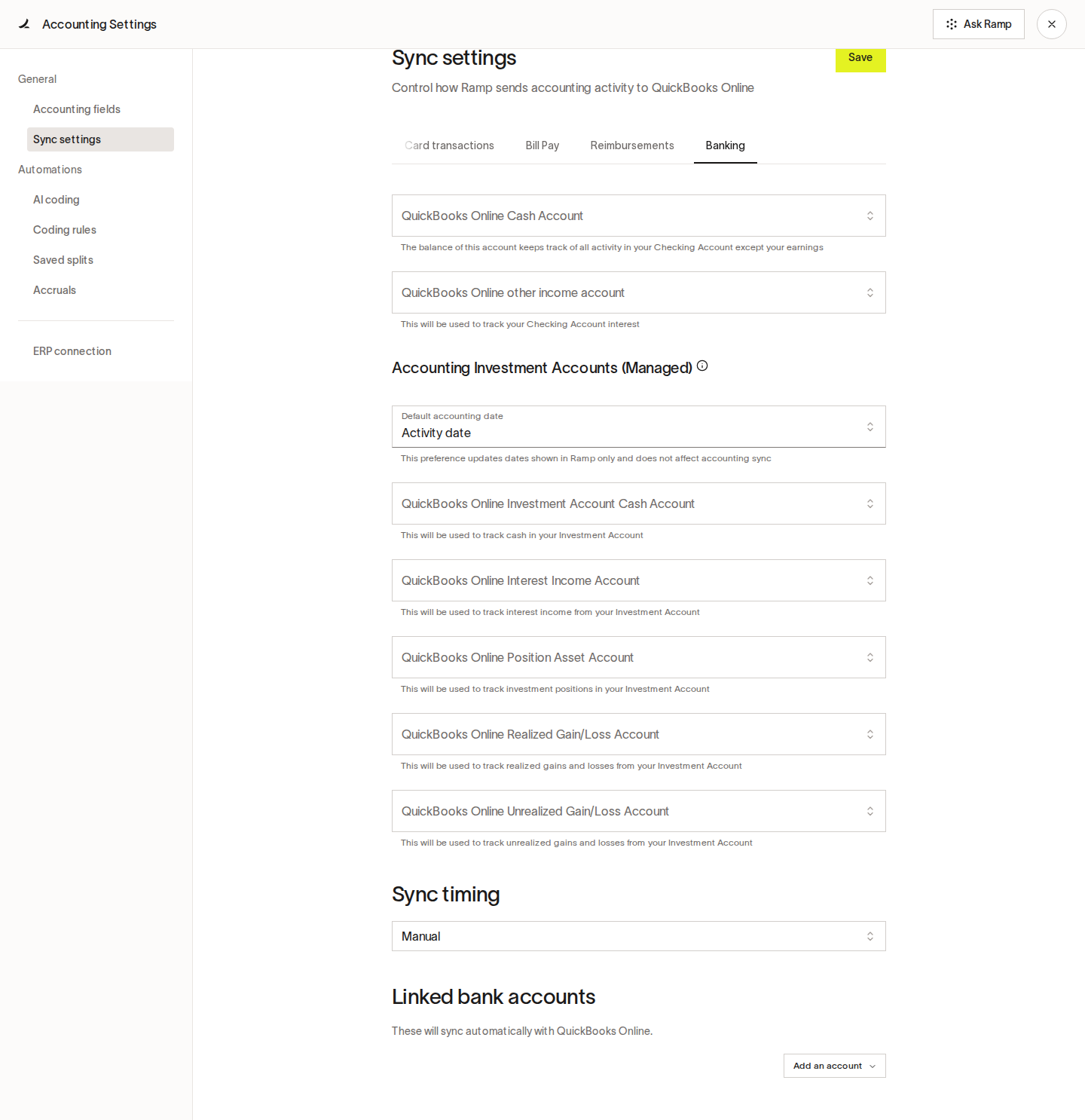
Open Ramp Banking sync settings. Under Accounting Investment Accounts (Managed), configure the five account mappings for your Managed Portfolio. You can select an existing account or create a new account in your chart of accounts.
Use Default accounting date to choose the date Ramp displays for Managed Investment Account activity:
- Activity date (default): The date the activity occurred, consistent with accrual-basis reporting.
- Processed date: The date the activity was processed, consistent with cash-basis reporting and Apex statements.
This setting changes only the date displayed in Ramp. It does not affect accounting syncs.
If you choose to create new accounts in your ERP to track Managed Portfolio realized gain loss and unrealized gain loss accounts, note these accounts will be created as Other Income - Other Investment Income accounts in your ERP.
Note: The position asset account reflects the current value of your investments, including both their original cost (adjusted over time) and any changes in market value.
QuickBooks Online:
What accounting entries should I expect for the managed portfolio?
For Xero, Managed Portfolio transfers sync as bank transfers. Managed Portfolio activities sync as bank transactions, except cash dividends and credit interest sync as manual journal entries.
The journal-entry examples below apply to QuickBooks Online, NetSuite, Sage Intacct, and Universal CSV.
Note: For cash dividends, Ramp syncs journal entries using the activity date. Apex monthly statements may show the same dividend using the processing date when cash settles, so the dates may differ during reconciliation.
Transfers: deposits and withdrawals
Whenever you transfer money into the Managed Portfolio, we record the movement of the transfer of funds.
Deposit into Managed Portfolio:
When funds are deposited into the Managed Portfolio, we record a journal entry that debits the Managed Portfolio cash account and credits the Ramp Checking Account.
Withdrawal from Managed Portfolio:
when funds are withdrawn from the Managed Portfolio, we record the reverse entry by debiting the Ramp Checking Account and crediting the Managed Portfolio cash account.
Account activity
Buy Orders:
When you place a buy order in your Managed Portfolio, we record a journal entry that debits the Position Asset account and credits the Managed Portfolio Cash account for the purchase amount.
Sell Orders:
When you place a sell order, we record a journal entry that debits the Managed Portfolio Cash account for sale proceeds, credits the Position Asset account for the carrying value removed (the part of what you owned that you no longer own after the sale), and records the difference as realized gain or loss. A realized gain or loss occurs when investments are sold for more or less than their recorded value, respectively.
Mark-to-Market: ongoing earnings and market changes (monthly)
We periodically update your books to reflect income earned, gradual price adjustments as investments move toward their repayment value, and overall market movements.
In your books, this results in updates to your investment balance, recognition of interest income for the period, and unrealized gains or losses from changes in market value. Unrealized gains or losses are not recognized as realized until an investment is sold.
These updates ensure your investment balance reflects its current economic (fair) value.
Cash dividends (monthly)
Some investments (such as stocks or funds) pay dividends, which are earnings generated from owning the investment.
In your books, dividends are recorded in two steps: first, we record the cash dividend as cash received and income earned, and then we record a separate buy entry for the automatic reinvestment of that cash.
Maturity
When a fixed-income investment reaches its scheduled maturity date, the issuer returns the principal and the position is closed.
In your books, this results in cash being recorded for the amount received, the investment balance being removed, any remaining unrealized gain or loss being reversed, and any final interest income being recognized. These updates ensure the investment is fully cleared from your books and that all remaining earnings are recognized when the investment matures.
Redemption
Some fixed-income investments are redeemed before or at payoff, which means the position is cashed out and closed.
In your books, this results in cash being recorded for the redemption proceeds, the investment balance being removed, and any previously unrealized gain or loss being reclassified into realized gain or loss. If there was interest associated with the investment, that may be recorded separately through interest payment activity before the redemption is booked. These updates ensure the investment is removed from your books and that the final economic result is recognized as realized at the time of redemption.
Credit interest
Credit interest represents interest earned on cash held in the managed portfolio rather than on a specific investment position.
In your books, this results in an increase to cash and recognition of interest income for the same amount. Because this activity relates to cash, it does not create or remove an investment position.
| Transaction | Description | Debits | Credits | Frequency |
|---|---|---|---|---|
| Deposit | Transferring money from Business to Investment Account | Managed Portfolio cash account | Ramp Checking Account cash account | As it happens |
| Withdrawal | Transferring money from Investment to Checking Account | Ramp Checking Account cash account | Managed Portfolio cash account | As it happens |
| Buy Order | Buying assets | Position Asset Account | Managed Portfolio cash account | As it happens |
| Sell Order | Selling assets | Managed Portfolio cash account Realized Gain/Loss Account (if loss) | Position Asset Account Realized Gain/Loss Account (if gain) | As it happens |
| Mark to Market | Periodic updates to reflect income earned, gradual price adjustments as investments move toward their repayment value, and overall market movements. | Position Asset Account | Interest Income Account Unrealized Gain/Loss Account | Monthly |
| Cash Dividends | Earnings paid for holding certain investments (e.g., stocks/funds). | Managed Portfolio cash account | Interest Income Account | Monthly |
| Redemption | When an investment is redeemed, cash is received, the position is removed, and any previously unrealized gain or loss is reclassified into realized gain or loss. | Managed Portfolio cash account Unrealized Gain/Loss Account (if applicable) | Position Asset Account Realized Gain/Loss Account | As it happens |
| Maturity | When a fixed-income investment reaches maturity, principal is returned, the position is closed, any remaining unrealized gain or loss is reversed, and final interest income is recognized. | Managed Portfolio cash account Unrealized Gain/Loss Account (if applicable) | Position Asset Account Interest Income Account | As it happens |
| Credit Interest | Interest earned on cash held in the investment account rather than on a specific investment position. | Managed Portfolio cash account | Interest Income Account | As it happens |
Frequently asked questions
Why did my investment balance change even though I didn’t deposit or withdraw funds?
Your balance changes due to market movements, earned interest, and amortization of securities toward their repayment value. These adjustments update your investment account to reflect its current fair value, even if no cash activity occurred.
What type of account should the Managed Portfolio asset account be in my ERP?
It is typically set up as an Other Current Asset if the investments are short-term and liquid. If your accounting policy treats them as longer-term investments, you may classify them as Other Asset. Confirm with your accountant for alignment with your reporting policy.
What are Mark to Market transactions under Accounting > Banking?
Mark to market means adjusting the recorded value of an investment to reflect its current fair market value, rather than the original purchase price. Instead of keeping an investment on your books at what you paid for it, its value is periodically updated based on what it’s worth today.
The journal entry we create is a consolidation of three events including:
- Accrued interest earned (interest that has been earned but not yet paid in cash)
- Discount/premium amortization (the portion of return from the bond pulling toward par over time. Par means the bond’s face value, typically the amount repaid at maturity)
- Unrealized mark-to-market movement (not realized yet through sale so unrealized)
Can I configure separate GL accounts for different asset classes?
No, we only allow you to configure one set of account for the whole of the Managed Portfolio Investment Account. We currently do not provide the ability for you to create separate sets of accounts for each asset class.
Can I see a breakdown of holdings inside my ERP, or only a summarized journal entry?
Supported ERPs receive summarized journal entries. Detailed holdings and position-level breakdowns remain available in your Ramp dashboard and statements.
Does this accounting follow GAAP?
No, these journal entries are suggestions. Consult your accountant to confirm treatment based on your company’s specific reporting and tax requirements.
Are advisory fees recorded automatically? If so, where?
Advisory fees are currently waived, so Ramp does not record advisory fee entries. See Managed Investment Account fee details for the waiver deadline and advisory fee.
Key terminology
Understanding the terms below will help clarify how Managed Portfolio accounting works.
Cost Basis: The original amount invested in a security, adjusted over time for amortization or prior sales. Cost basis is used to calculate realized gains or losses when an investment is sold.
Fair Market Value: The current value of an investment based on prevailing market prices. This is the amount reflected in your position asset account after mark-to-market adjustments.
Mark to Market: The process of adjusting the recorded value of an investment to reflect its current fair market value rather than its original purchase price.
Unrealized Gain or Loss: The change in value of an investment that has not yet been sold.
- If the market value increases above cost basis → unrealized gain
- If it decreases below cost basis → unrealized loss
Unrealized gains or losses become realized only when the investment is sold.
Realized Gain or Loss: The gain or loss recognized when an investment is sold. It is calculated as the difference between the sale price and the investment’s recorded value (cost basis).
Interest Income: Earnings generated from fixed-income securities such as bonds or money market funds. This is recorded periodically as income in your books.
Dividends: Payments distributed by certain investments (such as funds or equities). Dividends are recorded as income when received and may be automatically reinvested.
Amortization: The gradual adjustment of a security’s value over time as it moves toward its maturity or repayment value. This can increase or decrease the carrying value of the investment.
Liquidity: How quickly an investment can be converted to cash without significantly affecting its value.
Position Asset Account: The general ledger account that reflects the total current value of your Managed Portfolio, including original investment, amortization, interest, and market value changes.