Recover or update your MFA method
Overview
This article covers how to change your MFA method while signed in, and how to recover access if you are locked out. Ramp supports several phone-based delivery methods — SMS, voice call, and WhatsApp — as well as authenticator apps like Google Authenticator and Twilio Authy.
For general information about MFA methods, see Multi-factor authentication (MFA) overview.
Update your phone number (while signed in)
Update your own phone number
- Go to Settings > Personal settings .
- Click Edit my profile .
- Update your phone number.
- Enter the verification code sent to your new number to confirm the change.
Ramp uses your new phone number for future MFA verification once confirmed.
Have your admin update your phone number
An admin or IT admin can update the phone number on your account. This is useful if you are locked out or no longer have access to your current number.
- Ask your admin to go to Company > People .
- They click on your name, then click Edit profile .
- They update the phone number and click Save Changes .
You may need to verify the new number before it takes effect for MFA. For more details, see Updating user information in Ramp.
Update your authenticator app (while signed in)
- Go to Settings > Personal Settings > Security .
- Click Configure multi-factor authentication .
- Click Add authentication device and follow the on-screen instructions to register your new authenticator app.
- Return to the same screen and click the X next to your old authenticator to remove it.
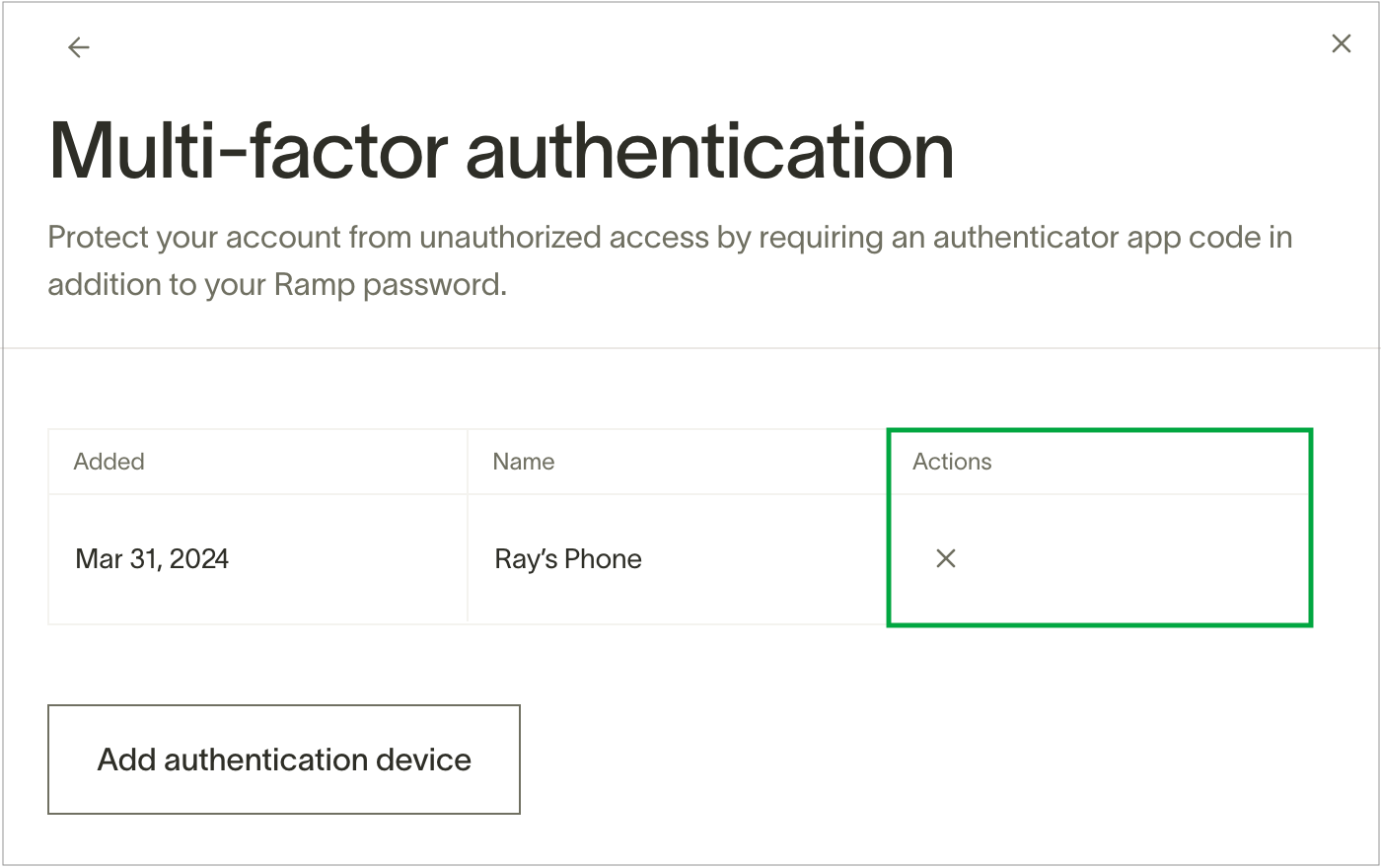
After removing the old authenticator from Ramp, also delete the Ramp entry from your old authenticator app:
- In Google Authenticator : press and hold the Ramp account, tap the pencil icon, then tap the trash icon.
- In Twilio Authy : go to Settings > Accounts and tap the delete button next to Ramp.
Recover access if you lost your phone or changed your number
If you are locked out because you no longer have access to your phone number, try these options in order.
Option 1: Ask your admin to update your phone number
This is the fastest path. Your admin or IT admin can update the phone number on your account without you needing to sign in. See Have your admin update your phone number above. Once they update it, return to the sign-in screen and sign in with MFA sent to your new number.
Option 2: Self-service recovery from the sign-in screen
-
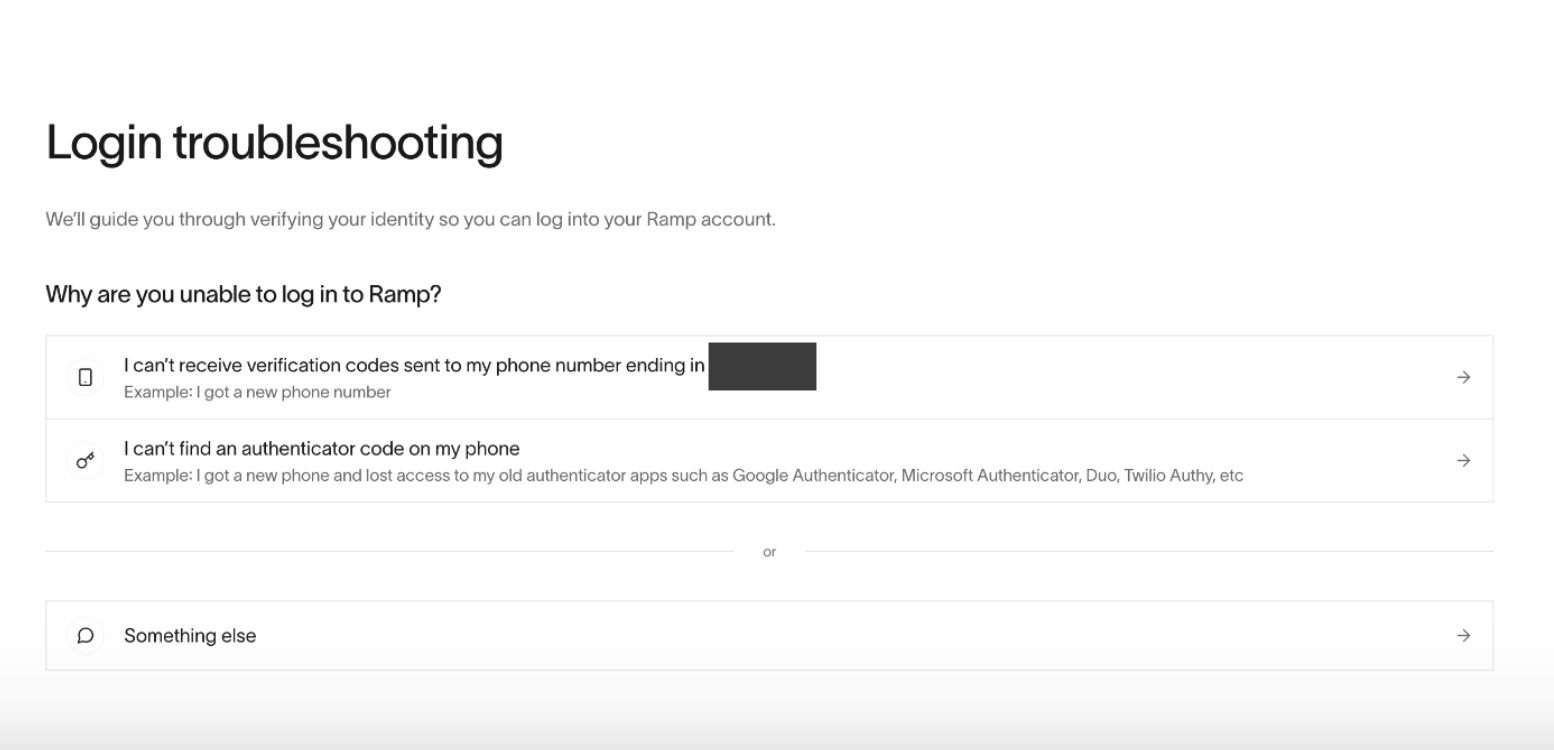
On the MFA verification screen, tap Having trouble?
-
Select I can't receive verification codes sent to my phone number .
-
Ramp sends a verification link to your email on file. Click the link in your inbox (check spam if needed). The link expires after 15 minutes.
-
Follow the prompts to diagnose the issue. If the guided steps do not resolve it, click I still need help .
-
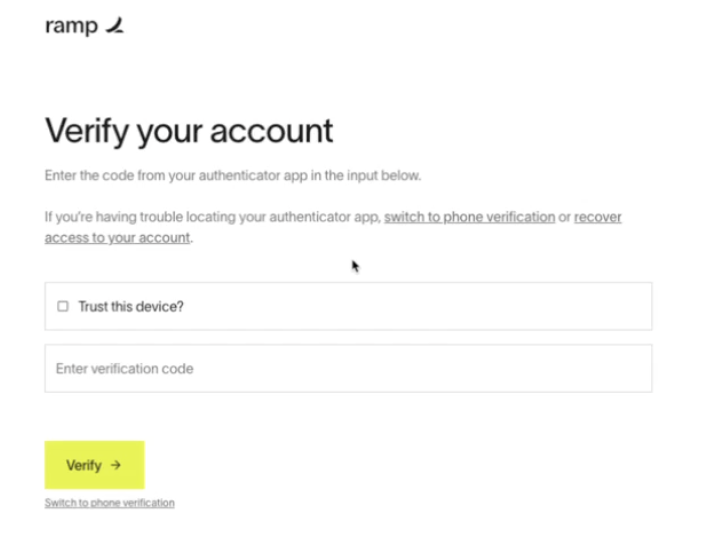
Enter your new phone number and submit the verification code sent to it.
-
Ramp runs a phone ownership check. If the check passes, you are returned to the sign-in screen with your new number active.
-
If the ownership check is not sufficient, Ramp directs you to verify your identity with Onfido .
International phone numbers
International numbers may not receive SMS from Ramp's US short code (447-267). On the MFA verification screen, select WhatsApp or voice call instead — both work reliably for international numbers. For other delivery issues, see Troubleshooting Ramp verification codes.
Recover access if you lost your authenticator app
If you are locked out because you no longer have access to your authenticator app, try these options in order.
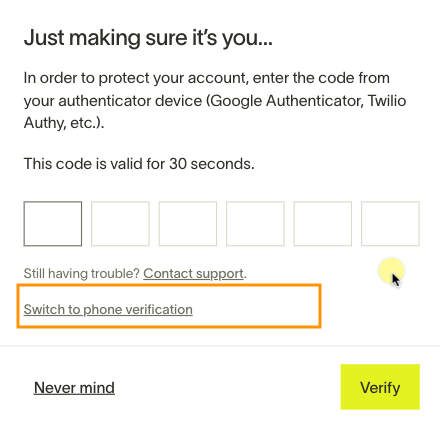
Option 1: Fall back to phone verification
If you have a phone number on file, Ramp may offer to verify you via SMS, voice call, or WhatsApp instead of your authenticator. Select that option to sign in.
Option 2: Self-service recovery from the sign-in screen
If phone verification is not available or does not work:
-
On the MFA verification screen, tap Having trouble?
-
Select I can't find an authenticator app code on my phone .
-
Ramp sends a verification link to your email on file. Click the link in your inbox.
-
If you have multiple authenticator apps registered, Ramp displays all their names so you can double-check each one. If none work, select Yes, I tried finding a code on all...
-
Ramp directs you to verify your identity with Onfido .
-
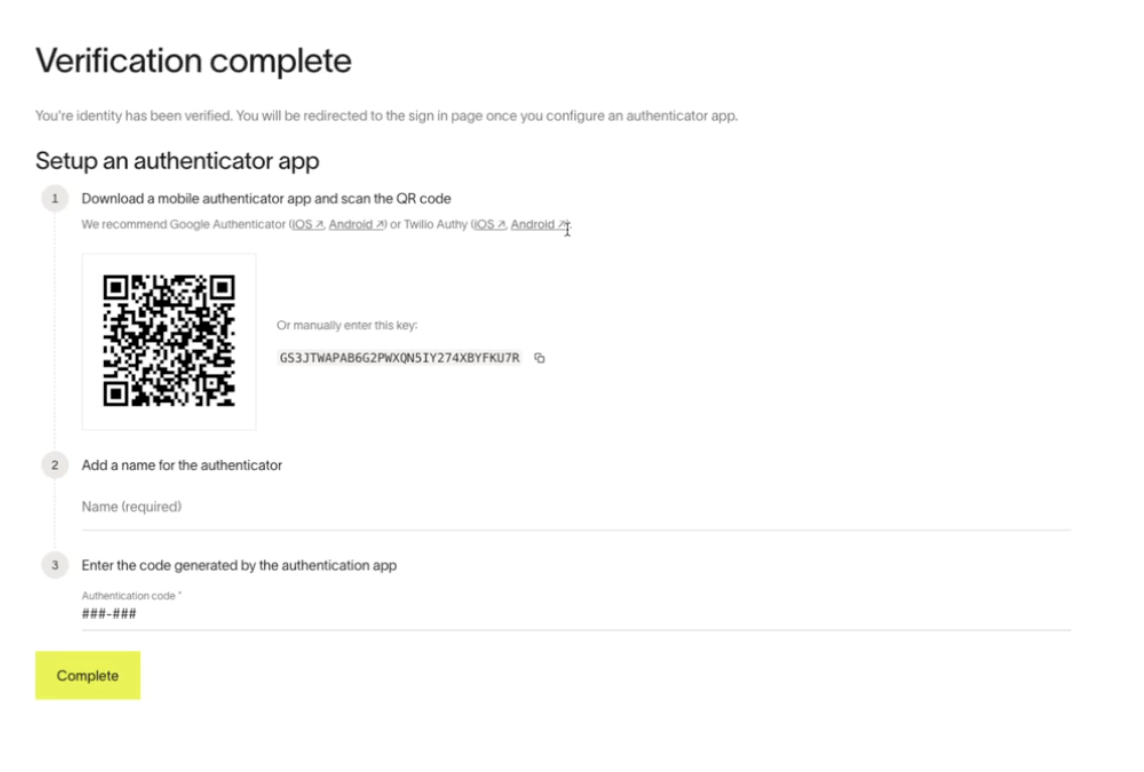
After verification succeeds, Ramp prompts you to set up a new authenticator app using a QR code or manual key. Name the authenticator, enter a verification code to confirm, and return to the sign-in screen.
After recovering access
The recovery flow adds a new authenticator but does not automatically remove the old one. Once signed in, go to Settings > Personal Settings > Security > Configure multi-factor authentication and remove the old authenticator to prevent it from being used to sign in. If you are unable to remove it yourself, contact Ramp Support.
Verify your identity with Onfido
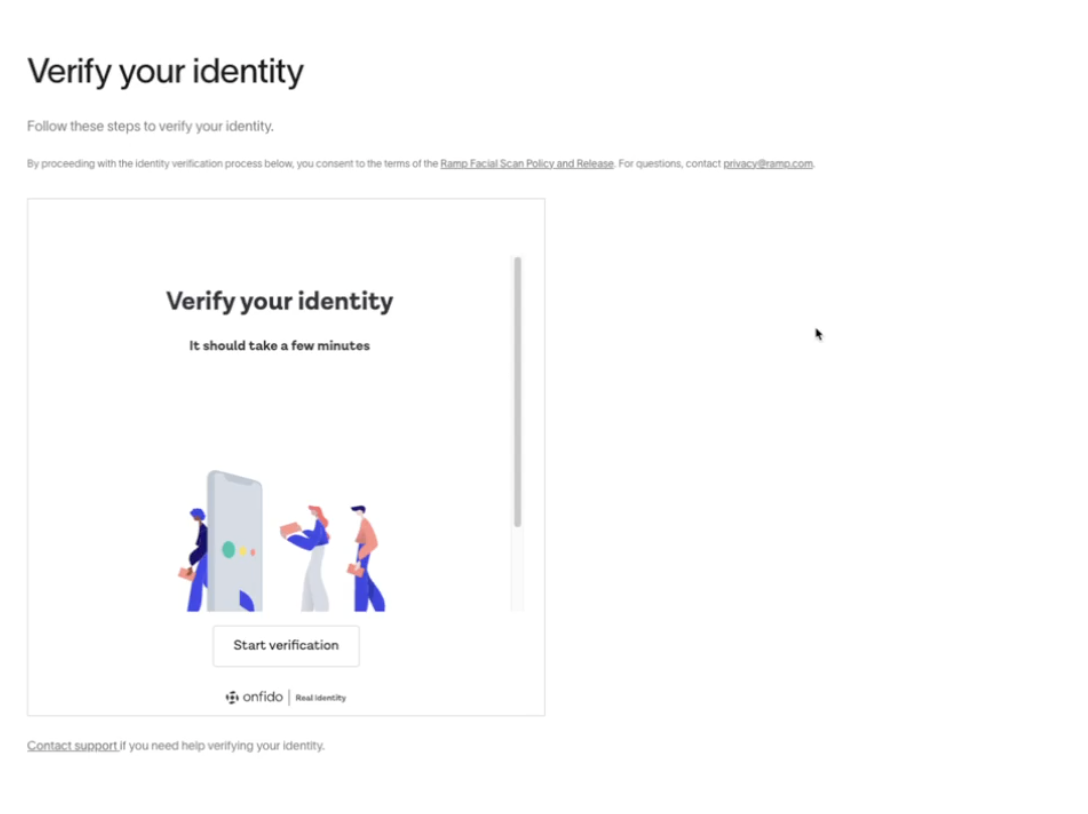
During account recovery, Ramp may ask you to verify your identity through Onfido, a trusted identity verification partner. For phone recovery, this happens only if the phone ownership check is not sufficient. For authenticator recovery, Onfido is always required.
What to expect
-
Click Start verification .
-
Select your country of residence.
-
Choose a government-issued photo ID (passport, driver's license, or national ID card).
-
Scan the QR code with your phone to open a secure page where you photograph your document.
-
Follow the on-screen prompts to capture your photos.
After verification
- If verification succeeds: You are returned to the sign-in flow. For phone recovery, you can sign in directly. For authenticator recovery, you set up a new authenticator first.
- If verification fails: You may retry with a different document. Common reasons for failure include blurry photos, expired documents, or a mismatch with the information on file. If retrying does not work, contact Ramp Support .
Verification typically completes within a few minutes. In rare cases, manual review may take longer.
Frequently asked questions
Can I receive MFA codes via WhatsApp?
Yes. WhatsApp is available alongside SMS and voice call as a delivery method for MFA codes. You can select it on the MFA verification screen, or set it as your preferred method from Settings > Personal settings > Communication preferences. WhatsApp is especially useful for international phone numbers that cannot receive SMS from a US short code.
Why am I being asked for MFA after using SSO?
Even with single sign-on (SSO), Ramp may prompt for additional MFA verification based on your business's security settings or risk-based checks. This helps protect sensitive actions within your account.
Can my admin help me regain access?
An admin or IT admin can update the phone number on your account (see Have your admin update your phone number), which may resolve your issue without the full recovery flow. However, admins cannot reset MFA settings or remove authenticator apps — those require Ramp Support.
I have an international phone number — what should I do?
Select WhatsApp or voice call on the MFA verification screen — both work reliably for international numbers that cannot receive SMS from Ramp's US short code (447-267). When entering a new number during recovery, include the correct country code. For other delivery issues, see Troubleshooting Ramp verification codes.
What if my identity verification fails?
You may retry with a different document. Common reasons for failure include blurry photos, expired documents, or a mismatch with the information on file. If retrying does not work, contact Ramp Support.
Should I set up a backup MFA method?
Yes. Having a second method — such as an authenticator app alongside your phone number — gives you a fallback if one becomes unavailable. Add an authenticator from Settings > Personal Settings > Security.
How many times can I attempt account recovery?
Self-service recovery is limited to 3 attempts within 7 days. This flow is available only for users who sign in with a password. If you use SSO-only sign-in or have reached the limit, contact your admin or Ramp Support.
For other sign-in and MFA issues not covered here, see Troubleshooting Ramp sign-in and MFA issues.