Ramp bank connections overview
Note: This article primarily applies to Ramp Administrators. Cardholders may find other articles in the Payments, limits, and statements section to be more applicable.
Overview
As a Ramp customer, you’re required to provide a connection to your business’s bank account. This can come in the form of a direct or a manual connection. Read more below about why we do it and how it works.
Bank connections
Why do we need a bank connection
Ramp uses data from your bank account to underwrite and maintain your business limit. When a customer links a business account, Ramp has access to a variety of information about the account, such as the cash balance and the transactions. It’s the best way to receive and maintain a higher credit limit. Learn more about Ramp business limits here.
How secure is it?
Our banking connection partners use bank-grade encryption to protect your data and we will never have access to your credentials.
Learn more about Ramp's security measures here.
Connecting directly
How do I connect my bank account directly?
If you’re already a Ramp customer, follow these steps to connect a bank account to your Ramp business:
- Navigate to Financial Accounts > Linked Accounts
- Click on ‘Add linked account’
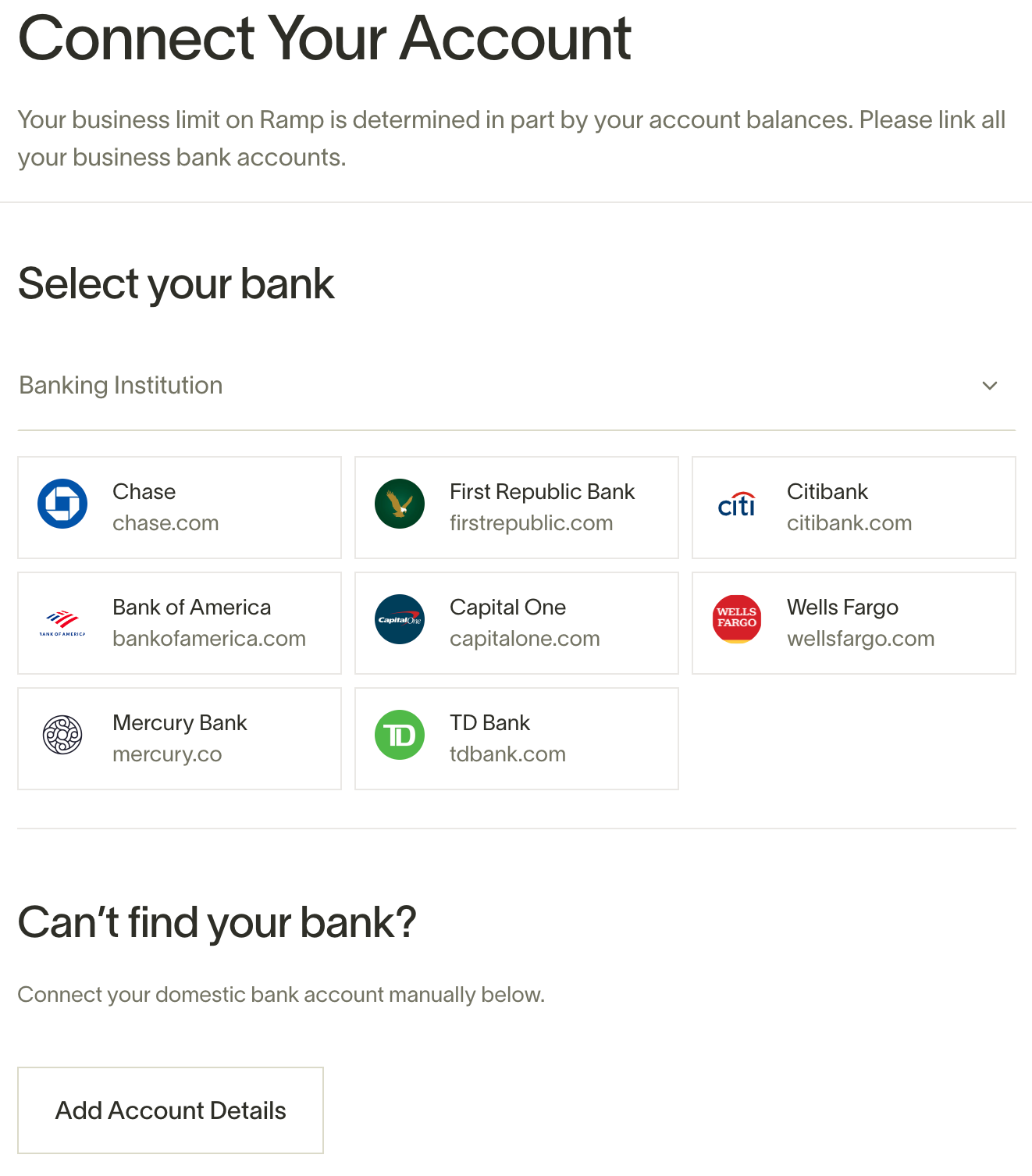
- Search for or select your banking institution and follow the prompts to connect your account
What if my bank account uses an OTP or an MFA?
Unfortunately, we cannot link to bank accounts directly if your account uses an One-Time Password (OTP) or has Multi-Factor Authentication (MFA) enabled. You can use the manual bank account connection process, which consists of providing a bank statement.
What if I have trouble connecting an account from a listed banking institution?
Sometimes direct bank linking will fail even if the banking institution is listed as ‘covered’. If you’ve tried and failed to connect an account from a listed banking institution, try these tips:
- Log on to your bank's website to confirm your credentials are working
- Check to see that there aren't messages from your bank on your bank's website
- If your sign-in credentials use multi-factor authentication (MFA) to log on to your bank, try connecting with an account that does not require MFA
- Try a different browser
- Disable the adblockers on your browser
- If you are based within the US, please ensure all VPNs on your device are disabled
- If your IP address is based outside the US, use a VPN with a US-based IP address before attempting to reconnect
- Check to make sure that you are selecting the correct account type for your banking institution in the Ramp search box
- Some institutions (such as Chase or Wells Fargo) have multiple account types listed on Ramp’s application
If you are still running into issues, please use the manual bank account connection process.
Connecting manually
Sometimes we require a customer to connect their bank account manually if the direct connection process doesn’t work.
How do I connect my bank account manually?
If you’re already a Ramp customer, follow these steps to connect a bank account manually to your Ramp business:
- Navigate to Financial Accounts > Linked Accounts
- Click on ‘ Add linked account ’
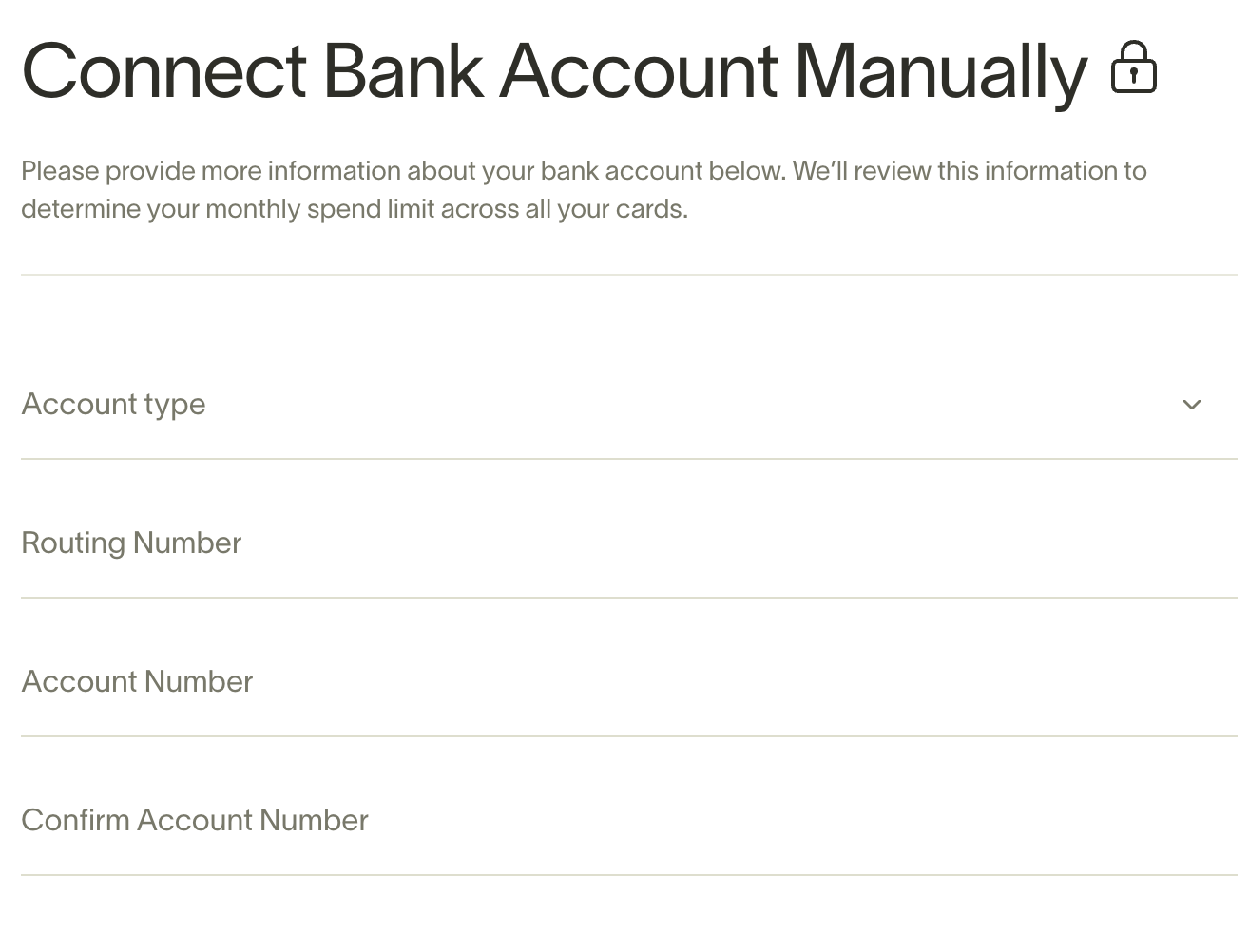
- Click on ' New Manual Connection '
- Enter the details requested and click ‘ Connect Account ’
- Upload the most recent bank statement for the account you are selecting by dropping the files into the box or click on it to browse your files
- Make sure the statement includes your cash balance and verifies you own the account
- The statement must be in PDF format — screenshots won’t suffice!
- We’ll assess the document and verify the account. If there are any issues, our Risk Operations team will contact you directly.
Where can I find my bank statements?
Sign in to your business’s banking portal and look for the term ‘Statement’. Sometimes it’s located under a section titled ‘My Documents’. Download your three current bank statements in PDF form, making sure the date range is as recent as possible.
Rename a bank account
Beta. This feature is currently in Beta.
You can add or update a nickname for any bank account from the Linked Accounts page.
- Go to Company > Financial Accounts > Linked Accounts
- Find the bank account you want to rename
- Click the three-dot menu next to that bank account
- Choose the rename option, then add or update the nickname
Verifying my bank account
We require debit checks or account verification of all bank accounts you use to make payments to Ramp. We require this when you are first onboarding, as well as when you switch the account you use to make payments.
What’s the debit check process?
The debit check process is a security measure Ramp uses to verify bank accounts. This process occurs when you first set up your Ramp account or add a new bank account for making payments. Ramp sends two small deposits and one withdrawal (equal to the sum of the deposits) to your bank account. After settlement (usually takes 4 business days), you'll need to sign in to your Ramp account and go to Financial Accounts > Linked Accounts There, you'll find a 'Verify' button next to your bank account, where you can enter the deposit amounts to complete the verification.
Why does Ramp require debit checks?
We do this to prevent fraud and reduce the chance that a payment you make fails.
How does this affect my limit?
When you successfully verify the bank account you’ll use to make payments, your full limit will be unlocked. Read more about Ramp Business Limits here.
How long does it take?
It takes four business days from when you initiate a debit check to when the transfer settles and you can verify your account(s).
Troubleshooting
"This bank account is a duplicate of an existing bank account connection"
This error appears when you try to add a bank account that matches an account already linked to your Ramp business. Ramp checks account details such as account number and routing number to detect duplicates. A bank account that is disconnected or has an expired connection still counts as a linked account, so re-adding the same account details will trigger this error.
What to do:
- If the existing connection is broken or expired, reconnect it instead of adding a new account. Go to Financial Accounts > Linked Accounts and click Resolve next to the disconnected account. For more details, see Reconnecting your direct bank connection .
- If reconnecting is not possible, you can add a different bank account with different account details.
"Cannot delete your last verified payment source"
Ramp requires at least one verified payment source at all times to process card statement payments. If you try to remove the only verified bank account linked to your business, you will see this error. The Remove connection option will be disabled for that account.
What to do:
- Add and verify a different bank account first, then remove the original account.
Both errors at once
In some cases, you may encounter both errors simultaneously: your only bank connection is broken, you cannot re-add it because Ramp detects it as a duplicate, and you cannot remove it because it is your last verified payment source. This can happen when a direct bank connection expires or requires re-authentication.
What to do:
- Try reconnecting the broken connection using the Resolve button on the Linked Accounts page. See Reconnecting your direct bank connection for step-by-step instructions.
- If reconnecting is not possible, try adding a different bank account with different account details.
- If neither option works, contact Ramp Support — a support agent can resolve the stuck connection on your behalf.
Debit blocks
If your bank account has a debit block or debit filter to prevent unauthorized debits/withdrawals from your account, payments on Ramp may get declined.
How do I lift a debit block from my account?
To make sure your bank lets us debit your bank account, please contact your banking representative and request to whitelist Ramps Originator IDs (also called ACH IDs). Please reference this Help Center article for the full list of Ramp's Originator IDs: How do I lift a debit block on my bank account?