Funds, cards, and spend programs
Overview
Funds are a set amount of money that can be spent from a physical card or reimbursed from. This gives the finance team additional control over company budgets and gives the cardholder an easy way to spend from one or more funds.
This powerful functionality makes spending and tracking even more effortless.
What are funds (fka cards), virtual cards, and physical cards?
Funds are a set amount of money your company provides you for general expenses you incur on behalf of your company. If you have a physical card, funds are designed to be used from your physical card.
- Some examples include a wellness stipend, an education stipend, or a travel stipend.
- Your finance team may set merchant restrictions, transaction amount restrictions, or other spending restrictions on your funds. You may view your funds and other restrictions from the Ramp web or mobile app.
Virtual cards are a type of funds restricted for use online and have their own card number. They cannot spend from your physical card.
- Some examples of when you might need a virtual card include managing several online payments for a single project.
- Ramp also has vendor cards, which are virtual cards for a single vendor.
Your physical card is how you spend any of your funds. It is a vehicle to access your funds. Without available funds, your physical card cannot be used for spending. Ramp will auto-match your transaction to the right funds based on your spend history, merchant name, amount, and restrictions on your funds.
A reimbursement is an expense you incur on behalf of your company from your personal card rather than your Ramp card. If your company has enabled reimbursements, these can also be applied against funds.
ASpend Program (fka card program) lets finance teams issue cards at scale by department, location, and other groupings. Employees may request cards from Spend Programs if the finance team has them set up.
What do my funds, virtual cards, and physical cards look like in Ramp?
An employee at Ramp may or may not have a physical card, funds, or virtual cards. What employees are issued will affect what they see when they sign in to Ramp.
- If you have a physical card and one instance of funds , all transactions on your physical card will be spent from those funds.
- If you have a physical card and multiple funds , you can spend them on your physical card, and Ramp will auto-match that transaction to one of your funds. More on how this works in the article section here→
- If you have a physical card, a single instance of funds, and multiple virtual cards , all transactions on your physical card will be spent on those funds. None of your transactions on your physical card will go towards your virtual card because those are only meant to be spent when making purchases online. You can click on your virtual cards to see transactions associated with that virtual card.
- If you have a physical card, multiple funds, and multiple virtual cards , you can make purchases from your physical card, and Ramp will auto-match that transaction to one of your funds. You can click on your virtual cards to see transactions associated with that virtual card.
What is auto-matching, and how does it work?
Auto-matching is when Ramp takes a transaction from your physical card or physical card number and matches it to the relevant funds. For example, if you purchase office supplies for work and you have funds for "education," "health and wellness," and "office," Ramp will automatically match it to the office funds. Please note that this setting is enabled by default when you have multiple funds.
When will the transaction go through?
- The transaction will go through as long as:
- You have funds with remaining spending greater than the transaction amount.
- The transaction meets all requirements or restrictions on those funds.
- If your transaction doesn't meet the above criteria and is declined, you are notified by a text message containing:
- The amount of the charge.
- The merchant.
- The funds the charge was matched to.
- The remaining spend on those funds.
- Any missing items for the transaction.
- You can move the transaction to another available fund by:
- Responding to the text message you receive after the transaction.
- On the My Ramp tab on the web.
- You can only move a transaction to other funds if the transaction was made with your physical card.
How do I switch a transaction to other funds if the transaction went through on the wrong funds?
If a transaction goes through on the wrong funds via Ramp auto-matching, you, your manager, or an admin on your Ramp account can move the transaction to another available fund.
For Cardholders:
- Go to the My Ramp tab.
- Navigate to the transaction in question.
- Select the “Spent from” dropdown.
- Select the correct funds for the transaction.
For Managers or Admins:
- Go to the Transactions subtab under the Expenses tab.
- Click on the transaction in question.
- Navigate to Spend from under the Summary section.
- Click the dropdown to see available funds.
- Select the correct funds for the transaction.
A few important notes:
- Transactions can generally be moved from any funds. The only instance when a transaction cannot be moved is when you use the physical card number and try to move it to funds restricted to virtual card-only.
- When a transaction is moved to different funds, the new funds' policies and approval chain now apply. For example, if you move your transaction from your Wellness funds to your Learning and Development fund, the Learning and Development fund’s policies now apply.
- Cardholders and managers can only move transactions to other funds before syncing them to the accounting provider. Only admins can change the funds after the transaction is synced.
How do I submit a reimbursement for my funds?
If you spend on your card and need your company to reimburse you, you may submit the reimbursement for your funds. When you create a reimbursement, the form has a field that allows you to select the relevant fund.
Important: If you’d like to reimburse towards a previous reimbursement period, please note that Ramp reimburses from the reimbursement period the transaction date is in.
For example, suppose you have funds whose limit resets monthly and reimbursement with a transaction date of last month you forgot to enter. If this month is August and the transaction occurred in July, the reimbursement is applied against the July funds.
You can also create a reimbursement from the fund itself.
- Select the funds from the My Ramp tab.
- Click “Actions.”
- Select Submit reimbursement to start a draft reimbursement.
What are other ways to use my funds?
- Generate a unique card number —If you need to purchase with your funds using a card number, you can generate one by clicking into your physical card or funds, navigating to the "Funds" tab, clicking on the funds you want a card number for, and clicking “Generate unique card number.” Once generated, you can always find it in the same funds tab.
- Lock funds –if you lock your funds, transactions towards them will be declined, and transactions on your physical card will not be spent from these funds.
- Archive funds —If you no longer plan to use your funds, you may archive them to remove them from your My Ramp screen. All transactions from the fund will remain in your account.
- Terminate funds —If you no longer intend to use them, you may terminate them. This action cannot be undone. The funds will no longer appear on Ramp, but all transactions from the funds will remain in your account.
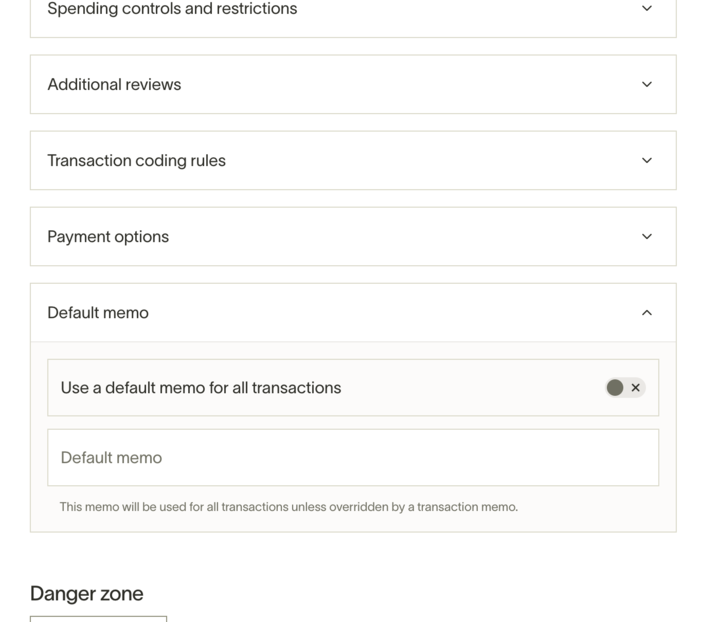
- Recurring memos —You can specify a default memo that will be auto-set for all transactions made within a particular fund. This serves as another layer of automation for our users, especially for those using single-purpose funds!
Additional notes:
- You may choose to have your physical card spend from specific funds rather than auto-matching. To do this, click on your physical card and select specific funds.
- A physical card must have funds available to function.
- If the funds linked to your physical card are terminated, the physical card will be declined because it no longer inherits the limit or settings from the funds You must either link other funds or request funds for the physical card to link to.
- When a member of a shared fund with recurring charges is terminated, their virtual cards are deactivated and charges will be declined.
- Issue a new virtual card from the shared fund to an active user to continue payments.
- Update the vendor's payment method to use the new card.
- Ramp does not offer a company-wide setting to block all new virtual card or fund requests. Requests must be manually approved or denied by Admins/Managers.